The essentials
- A whale is usually spotted as a puff of vapour that hangs for a moment before the wind tears it apart, so crews scan the horizon in slow arcs rather than staring at one spot.
- When gulls and diving birds work the surface in a crowd, small fish are being pushed up from below, and feeding whales are often working the same patch of water.
- Skippers in the bay keep in touch by radio and pass on positions, so a sighting found at one end of Skjálfandi can be checked at the other end before it is lost.
- Each humpback tail carries its own pattern of black and white, scars and nicks, and the photos taken on tours help crews recognise the same whale again in later seasons.
- Boats approach from behind and to the side and cut speed early, keeping engine noise down while a whale is at the surface and leaving room for it to feed calmly.
- Top choice Big Whale Safari & Puffins from US$171 Duration2 hours[1]Rated4.73 from 1,423 reviews[1]RouteHusavik, Puffin Island, Skjálfandi[1]RefundsFree cancellation up to 24 hours[1]GuideLive tour guide: English[1] Check availability
- Big Whales & Puffin Island from US$164 Duration2 hours[2]Rated4.83 from 1,059 reviews[2]RouteHusavik, Puffin Island, Skjálfandi[2]RefundsFree cancellation up to 24 hours[2]GuideLive tour guide: English[2] See this tour
- Whale Watching with a Guide from US$99 Duration3 hours[3]Rated4.63 from 2,958 reviews[3]RouteNot listedRefundsFree cancellation up to 24 hours[3]GuideLive tour guide: English[3] See this tour
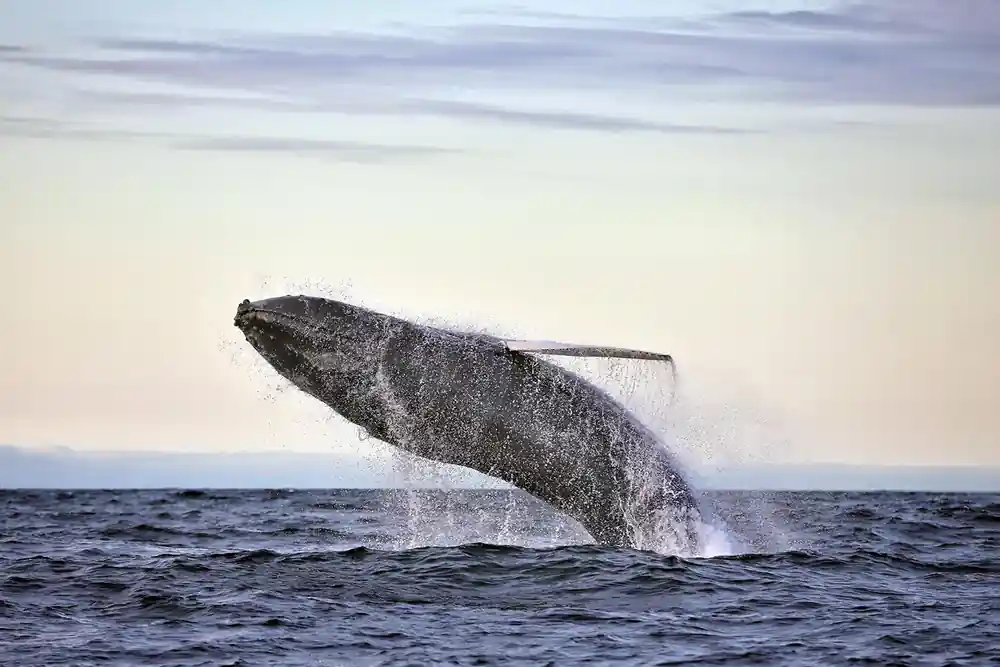
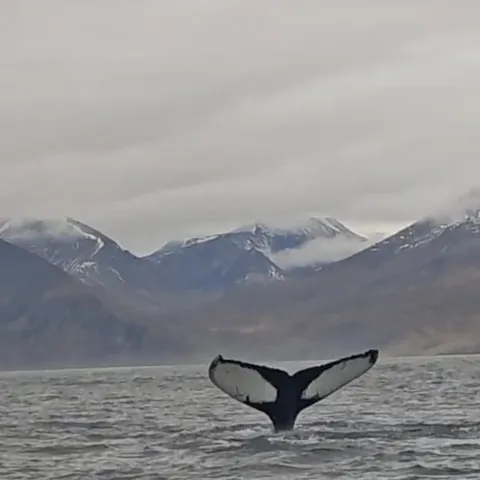
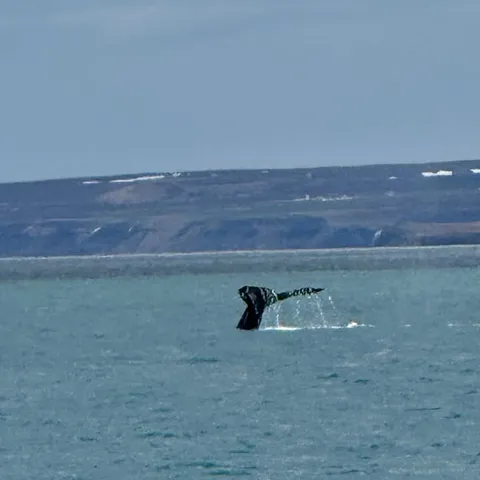
To provide realistic expectations to spot whales, we have gathered data of sightings in Skjálfandi Bay from every tour since the beginning of whale watching in 1995 in Húsavík. The results are truly impressive, with a 97% success rate of overall sightings!
How the crew find whales: the short answer
Before you board
- Book a day or two into your trip so a weather cancellation leaves room to rebook
- Wear a thermal base layer under a windproof jacket, even in midsummer
- Keep your booking confirmation on your phone and be at the harbour early
- If you are prone to seasickness, take a tablet before you board rather than after
On the water
- The speedboat safari spends 2 hours on the water from Húsavík harbour[1]
- Bring sunglasses, because glare off the bay is strong even under cloud
- Keep the camera strap on your wrist and a dry cloth in a pocket
- Stay seated while the boat is moving and watch the crew for hand signals
Reading the Blow: Spotting Whales from Miles Away
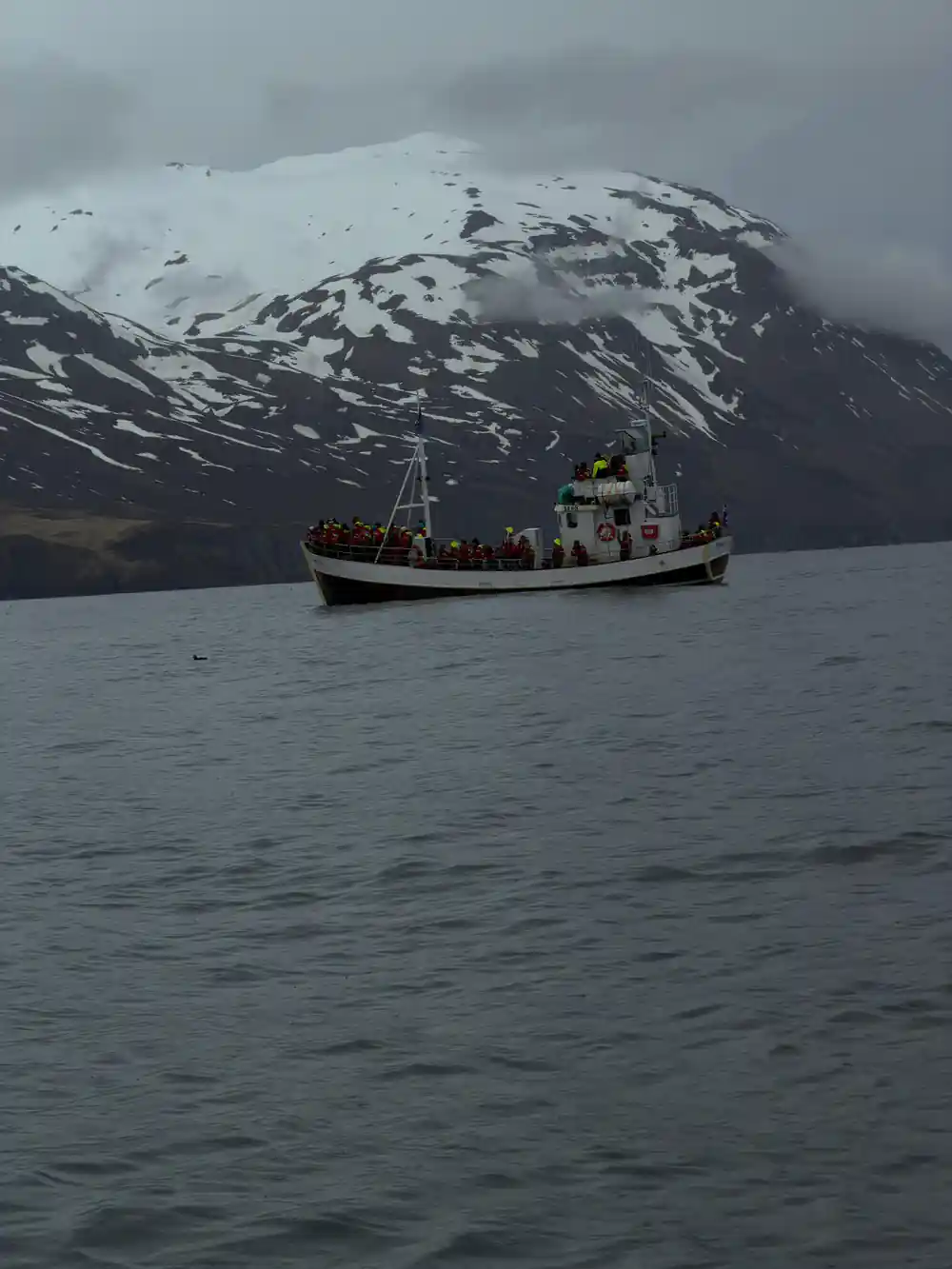
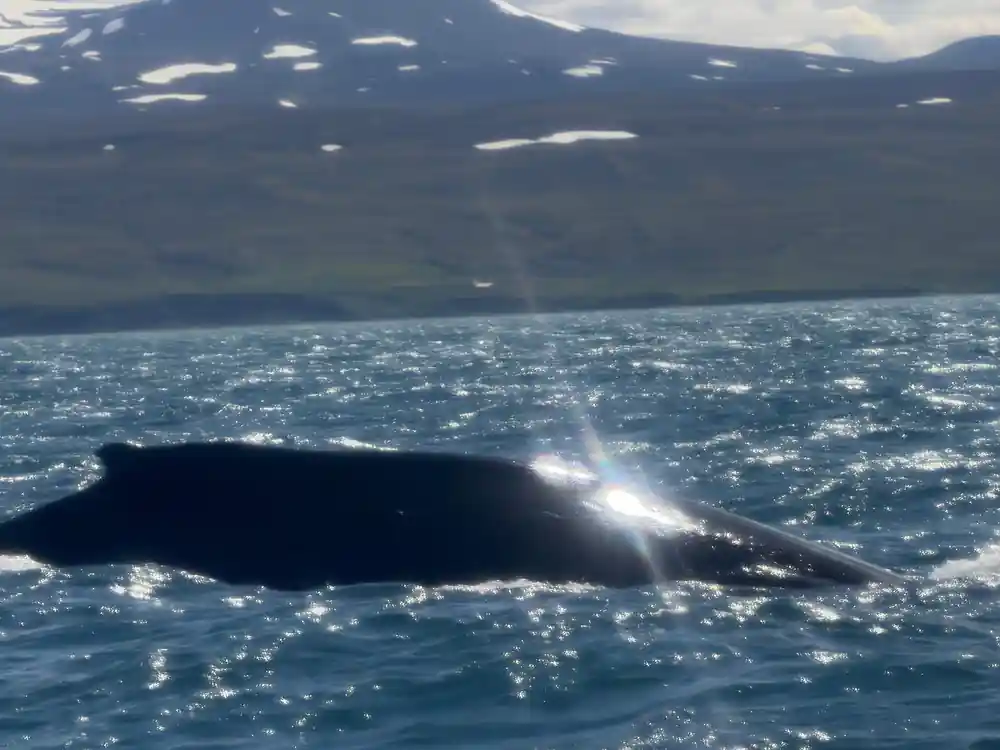
The water in Skjálfandi Bay is rarely glassy, and that is part of the challenge. A whale is usually spotted by its blow: a plume of warm air and vapour that shoots up, hangs for a moment and then thins into the wind. Crews sweep the horizon in slow arcs, watching for that white flick against grey water. The Whale Trail's shoreline advice holds on the water too: look for boats, especially if they are stopped, because a stationary vessel usually means somebody has found something.[4]
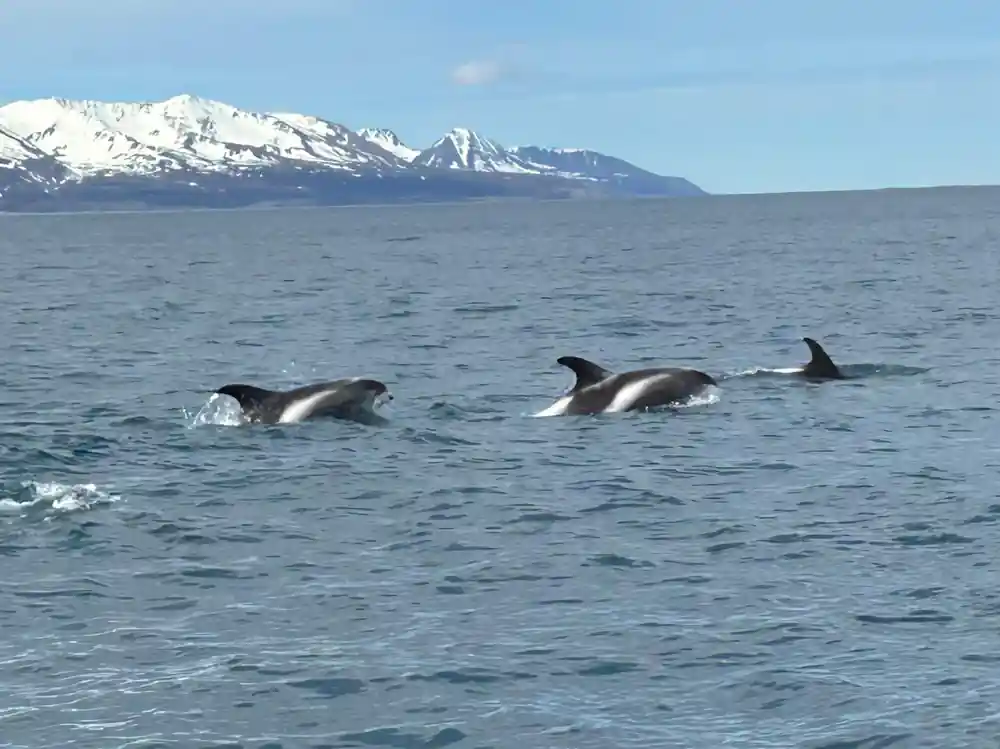
The search area is big. Skjálfandi Bay is about 28 km wide at its widest point and about 25 km long.[5] There is no corner of it that a skipper can drive to and wait in. North Sailing says there is a chance to encounter up to 11 different cetacean species on its tours, and no two spouts look quite the same.[6] Some species throw a low, quick puff of spray; a humpback throws a tall, bushy column that carries a long way. Height, shape and the way the spout breaks up all narrow the guess.
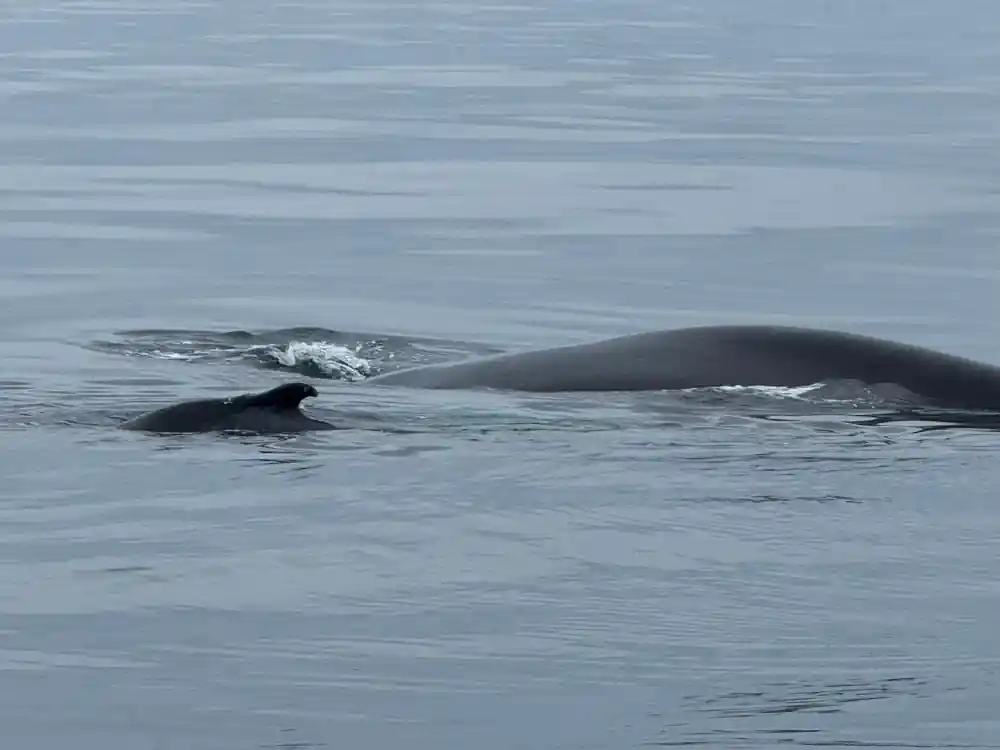
Weather decides the method as much as anything. On grey days the sea merges with the sky and a blow is often easier to catch with the naked eye than through binoculars, because the field of view is wider. In flat calm the water shows a slick, a smooth patch left by a whale just under the surface, and a tail print, the ring of disturbed water where a fluke went down. Both vanish quickly.
Feeding Birds and Bait Balls: Reading the Water
Birds are the other set of eyes. When a current pushes plankton and small fish together, the surface above a bait ball starts to boil: gulls, fulmars, kittiwakes and terns drop in from every direction while diving birds vanish and reappear with something silver. Crews read that commotion as a map. Where the fish gather, the whales that feed on them are rarely far away, and a flock that keeps working the same patch of water is worth a detour.
Puffins add a second layer to the search. Lundey, the small island in the bay that everyone calls Puffin Island, is described as a nesting ground for around 36,500 active breeding pairs of puffins.[7] The speedboat safari runs from Húsavík to Puffin Island and on into Skjálfandi.[1] That gives you the bird cliffs and the open water where whales feed on the same outing. In puffin season the air around the island fills with birds circling with beaks packed with sandeels.
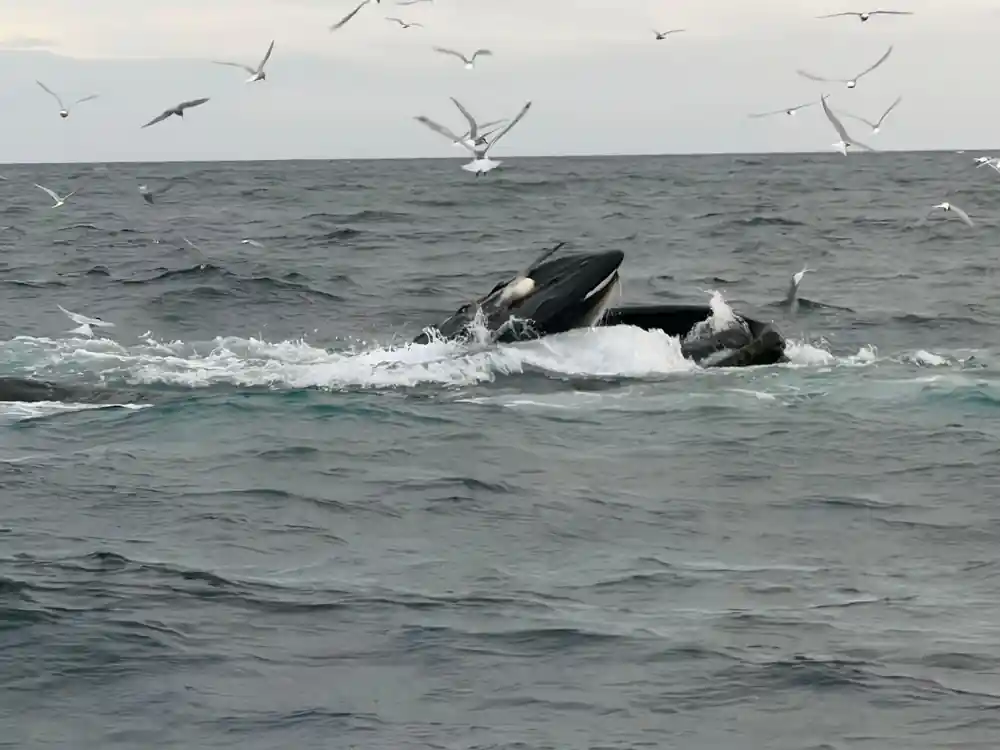
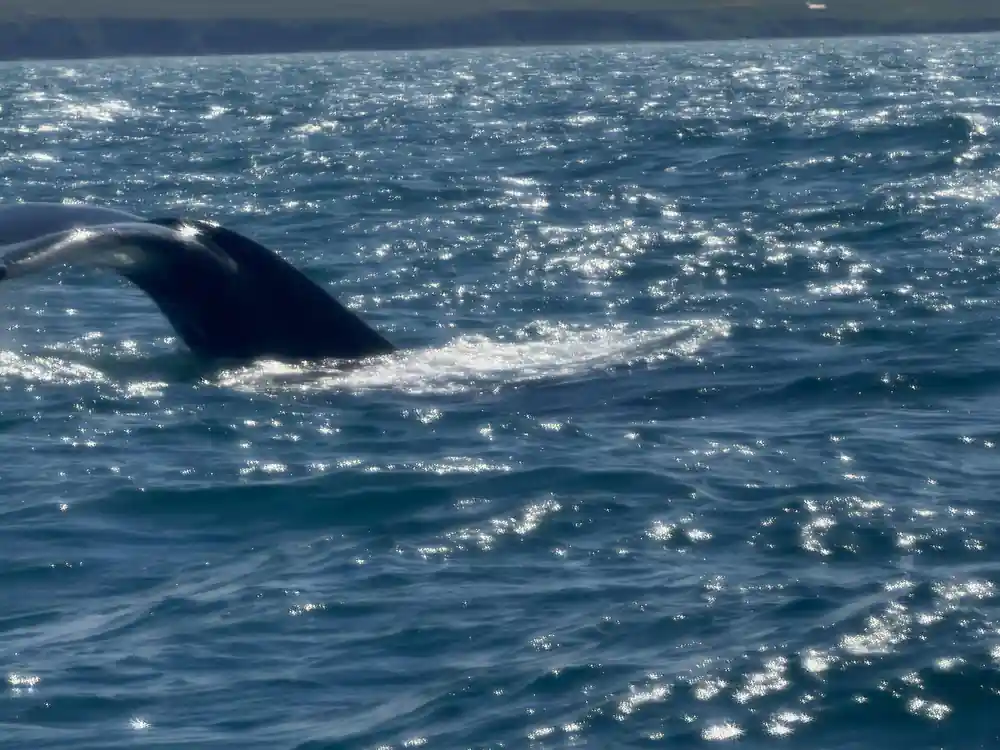
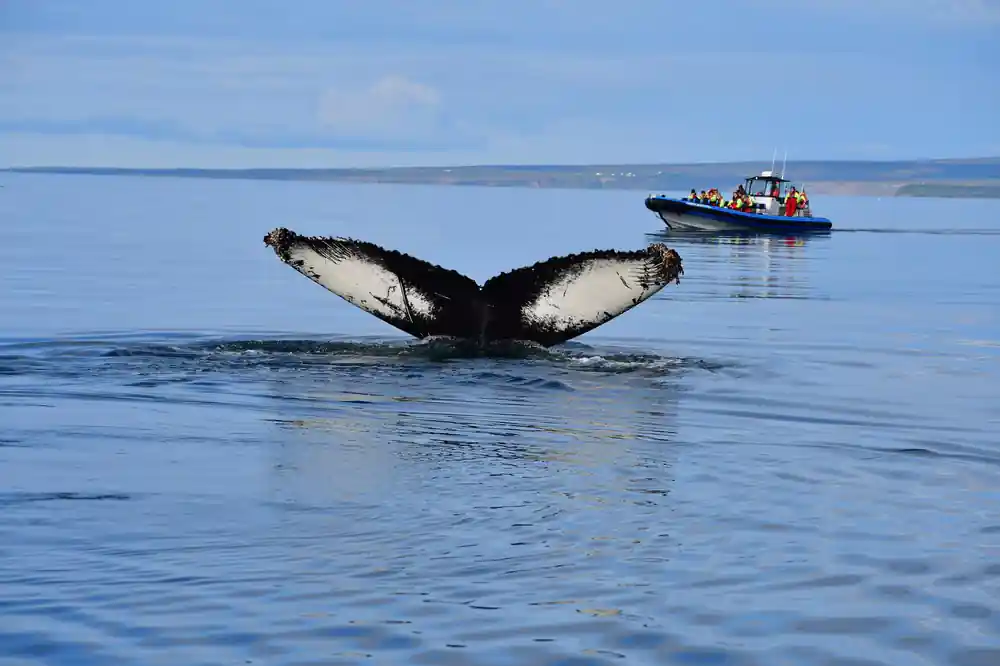
A fluke in calm water, with snow still lying on the mountains behind the bay.
The Húsavík Radio Network: Sharing the Search
Whale watching here is a small-town business, and the boats behave like it. Skippers keep a radio channel open between vessels, passing on positions, direction of travel and how long ago the animal dived. On a busy afternoon the effect is a search party rather than a race: a minke found off one side of the bay can be picked up by a boat that has been staring at empty water for a long stretch. Sharing does not guarantee anything, but it spreads everyone's luck.
The habit has deep roots. Commercial whale watching in Iceland began in Húsavík in 1995, and the same families and companies still run many of the boats.[8] Húsavík has a population of roughly 2,500, and on a summer morning the harbour is where the town gathers.[9] The name means the house bay, from the Settlement Book account of Garðar and Náttfari, who set up their winter camp in Skjálfandi Bay and built a house here.[10]
Fluke Photo-ID: Identifying Individual Whales
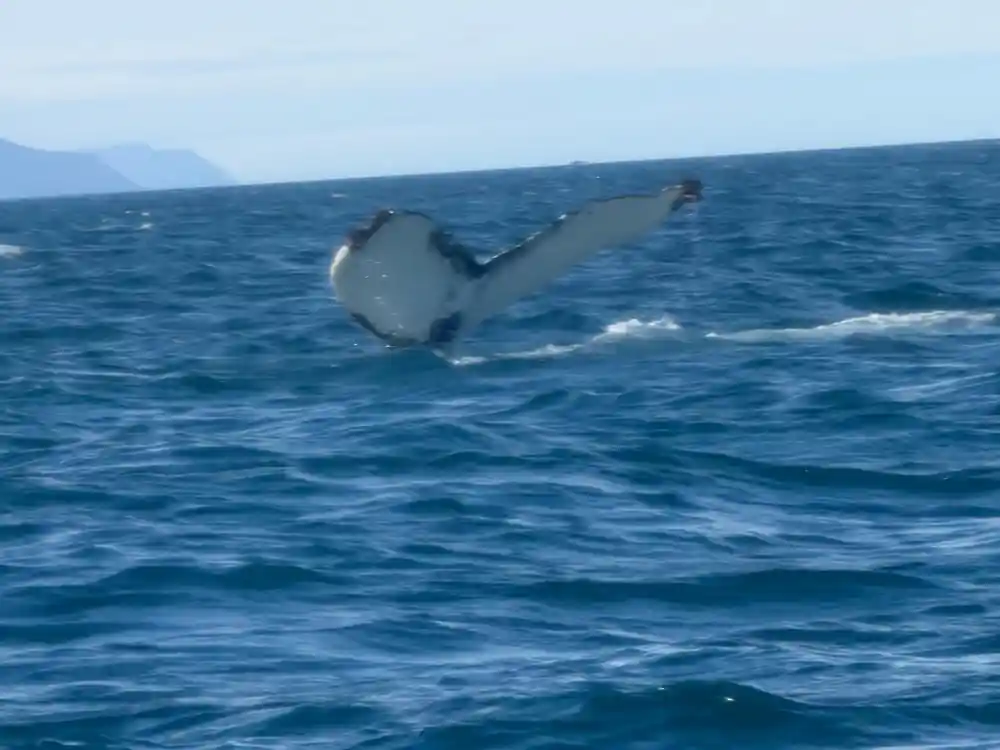
When a humpback lifts its tail before a long dive, the underside is as individual as a fingerprint, with black and white patterns, scars and nicks that last for years. Guides photograph every fluke they can, and matching a picture against a catalogue tells them whether this is a regular visitor or a new arrival. Size sets the scale: humpbacks in the Northern Hemisphere reach an average length of 49 to 52 feet, southern humpbacks reach 60 feet, and mature adults average 50,000 to 80,000 pounds.[11]
The cataloguing has a public home. The Húsavík Whale Museum was founded in 1997, with the aim of giving detailed and interesting information about whales and their habitat.[12] Skeletons, models and display boards sit a short walk from the harbour, and an hour there turns a shape seen at sea into a recognisable individual with a known history. On the water, a skipper may talk about a whale by name or number rather than just calling it a humpback.
97%
North Sailing reports a 97% overall whale sighting success rate on its Húsavík tours, based on sightings in Skjálfandi Bay since 1995.[6]
Research Data Logged Every Trip
Every trip produces records: the time and place of each sighting, the species, the behaviour, the number of animals and the state of the sea. Guides write them down between trips, and the pile of seasons has grown into one of the longest running records of whales in Icelandic waters. North Sailing says its Húsavík whale watching tours have had a 97% overall whale sighting success rate based on sightings in Skjálfandi Bay since 1995.[6]
What the logs do for passengers is quieter than a promise. They tell crews where the food has been in the past few days, which species have moved in, and whether a whale has stayed in the same part of the bay. They also feed museum displays and the research projects that use the bay as a base. None of it is glamorous: a clipboard, a camera and a spreadsheet at the end of a long day.
Crews also use the logs to plan. If the same humpback has been working one stretch of water day after day, that is where the boat goes first, and the birds usually confirm it. Passengers who ask questions on the way out often get a running commentary on what the crew expects to find, and why they have chosen that line across the bay.
Icelandic Approach Rules and Whale Comfort
Whale watching in Iceland follows a code of conduct, and the way a crew behaves around an animal is deliberate rather than timid. Drivers approach from behind and to the side of a whale's line of travel, slow down well before they arrive, and never cut across its path or split a group. Speed is saved for the crossing. The RIB Express boat, for example, has a comfortable cruising speed of 32 knots, which shortens the run out to the feeding grounds, but nothing like that pace is used alongside a whale.[13]
Comfort matters as much as distance. In summer the average sea water temperature in Skjálfandi Bay rises to 8.8 C, bracing even on a warm day, and the wind on a fast boat makes it feel colder.[14] In Iceland the sun never fully sets from May through August, and the midnight sun peaks around the summer solstice in June.[15] Bring a windproof outer layer, gloves and a hat, and add a thermal layer underneath.
Predicting the Next Surfacing: Reading Whale Behaviour
After the first sighting, the work shifts from searching to predicting. A feeding humpback takes a few shallow breaths, shows its back, then lifts its fluke and dives deep. The crew count in their heads and steer a gentle arc towards the spot where the animal should come up. A long dive means a long wait in the right place rather than a chase in the wrong one. Minkes and dolphins move faster and less predictably. The engine stays ready and the birds stay in view.
The last part of a trip often feels unhurried. The Original Big Whale Safari and Puffins by Speedboat spends 2 hours on the water, with free cancellation up to 24 hours in advance, and the route runs from Húsavík to Puffin Island and into Skjálfandi.[1] Crews give a whale quiet minutes at a distance rather than crowding it for a photograph. If the animals stay down, the ride back across the bay is its own reward.
Time on the water by Húsavík whale tour
What a Húsavík whale safari costs from
All amounts are US dollar from-prices of these listings, child rate repeated where none is listed.[1][2][3][16]
When to book a Húsavík whale safari
How the crew find whales
Scan the horizon
Watch for a blow, the plume of vapour that rises and vanishes. Sweep in slow arcs, and note where other boats have stopped.[4]
Follow the birds
Gulls and diving birds working one patch of water usually mean fish pushed to the surface, and feeding whales underneath them.
Talk to other boats
Skippers pass positions on by radio, so a sighting at one end of Skjálfandi Bay can be checked at the other end before it is lost.
Slow down and angle in
Approaches come from behind and to the side, with speed cut early. A whale that is not being chased tends to stay up longer.
Photograph the fluke
A tail shot identifies an individual whale, and crews use those photos to follow the same animals across seasons.
Log what you saw
Time, place, species and behaviour go into the trip record, which builds the picture for the next day on the water.
Join a Húsavík whale safari with the crew who find the whales
from US$172Reserve now & pay later