The essentials
- Humpbacks, minkes, white-beaked dolphins and harbour porpoises are the regular cast, with orcas and blue whales as the occasional bonus.
- North Sailing reports a 97% overall whale sighting success rate in Skjálfandi Bay, based on sightings recorded since whale watching began in Húsavík in 1995.[1]
- The Original Big Whale Safari & Puffins by Speedboat takes 2 hours and runs from Husavik to Puffin Island and into Skjálfandi.[2]
- Dress as if for a winter walk: warm layers, a windproof outer shell, hat and gloves. The bay is colder on the water than it feels in town.
- The GeoSea Geothermal Sea Baths sit on the headland outside town, with seawater from geothermal boreholes kept at 38 to 39 °C year-round.[3]
- Top choice Original Big Whale Safari from US$171 Duration2 hours[2]RatingRated 4.73 from 1,423 reviews[2]GuideLive tour guide: English[2]CancellationCancel up to 24 hours in advance[2] Check availability
- Big Whales and Puffins from US$164 Duration2 hours[4]RatingRated 4.83 from 1,059 reviews[4]GuideLive tour guide: English[4]CancellationCancel up to 24 hours in advance[4] See this tour
- Whale Watching with Guide from US$99 Duration3 hours[5]RatingRated 4.63 from 2,958 reviews[5]GuideLive tour guide: English[5]CancellationCancel up to 24 hours in advance[5] See this tour
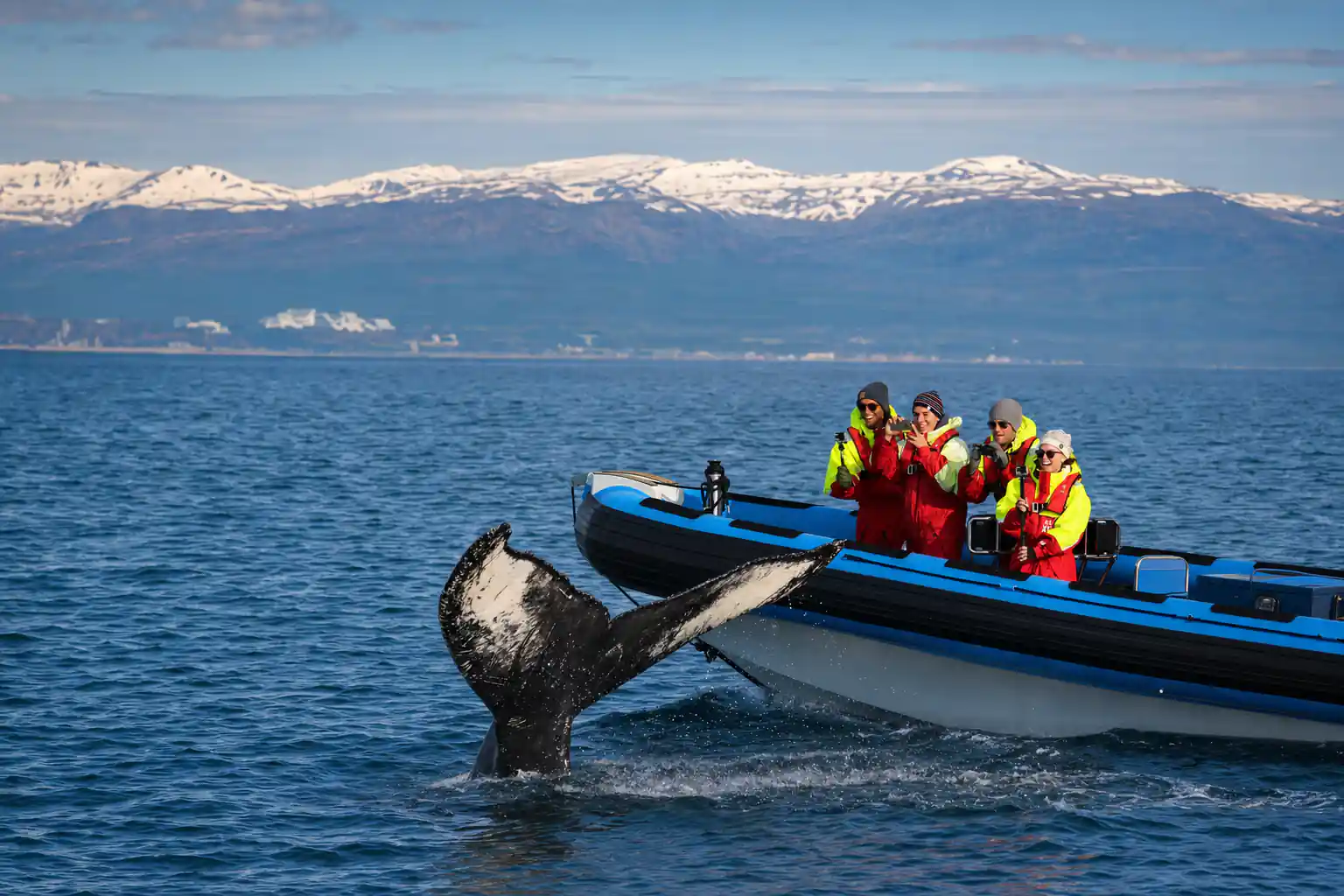
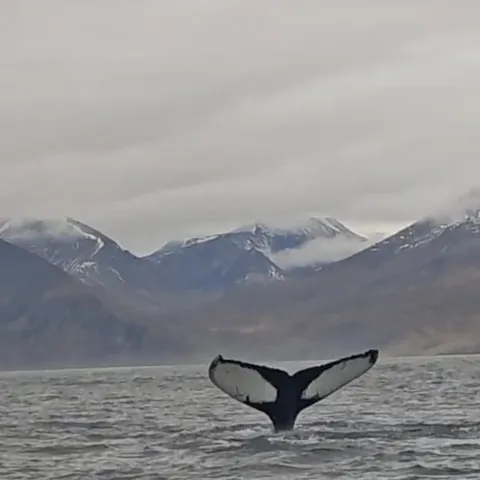
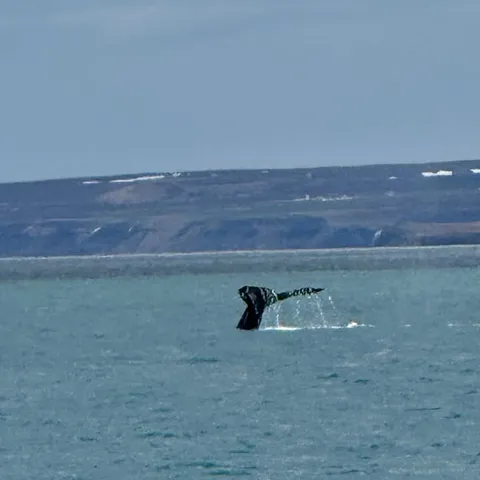
To provide realistic expectations to spot whales, we have gathered data of sightings in Skjálfandi Bay from every tour since the beginning of whale watching in 1995 in Húsavík. The results are truly impressive, with a 97% success rate of overall sightings!
Is a Húsavík whale trip worth it?
Getting ready
- Book ahead for summer dates, when Húsavík is at its busiest
- Allow a little extra time in town before your departure
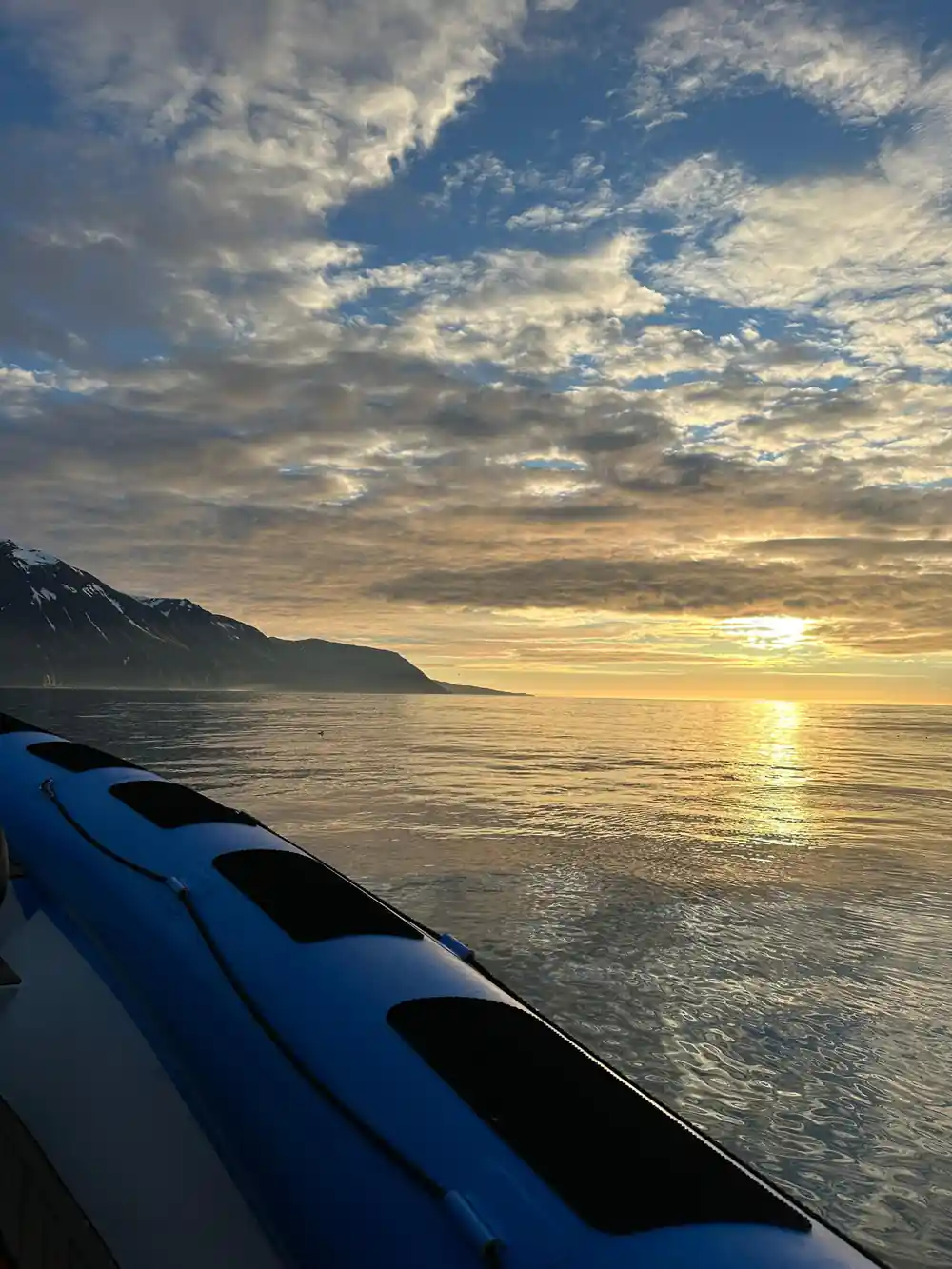
- In May through August the sun never fully sets, so late trips stay bright[6]
- Whale tour listings in Húsavík quote from prices in US dollars
Why Skjálfandi Bay Attracts So Many Whales
Skjálfandi Bay is about 28 kilometers wide at its widest point and about 25 kilometers long.[8] That is a lot of open water on the doorstep of a small town; Húsavík itself has a population of roughly 2,500.[9] The bay faces north toward the Arctic, and cold currents move through it carrying the small fish, krill and sand eels that baleen whales feed on. Cold water also holds oxygen well, and the shallow shelves under the bay keep that food near the surface, within reach of animals that have to come up to breathe.
The name fits the place. According to the Settlement Book, Garðar and Náttfari set up their winter camp in Skjálfandi Bay and built a house in Húsavík, which means 'the house bay'.[10] Whale watching arrived much later: commercial whale watching in Iceland began in Húsavík in 1995.[11] North Sailing says its Húsavík whale watching tours have had a 97% overall whale sighting success rate, based on sightings in Skjálfandi Bay since 1995.[1] That figure covers sightings overall rather than one species; treat it as encouragement rather than a guarantee.
You can see whales from Húsavík on a trip of a couple of hours, and on North Sailing tours there is a chance to encounter up to 11 different cetacean species.[1] What follows is a rough guide to the cast: humpbacks, minkes, white-beaked dolphins, harbour porpoises, and the bigger visitors that only some summers bring. The Húsavík ocean is cold, bright and full of food, and every crossing arranges the same characters differently.
Humpback Whales and Their Bubble-Net Feeding
Humpbacks are the whales most people picture, and they are the ones you are most likely to spend time with in Skjálfandi Bay. They are dark on the back and pale underneath, with a knobbly head, a small curved dorsal fin, and flippers that look absurdly long when a whale rolls onto its side. Humpbacks found in the Northern Hemisphere reach an average length of 49 to 52 feet, and southern humpbacks reach 60 feet, with mature adults averaging 50,000 to 80,000 pounds.[12] Sitting in a small boat while something that size decides to surface nearby is the memory most people take home.
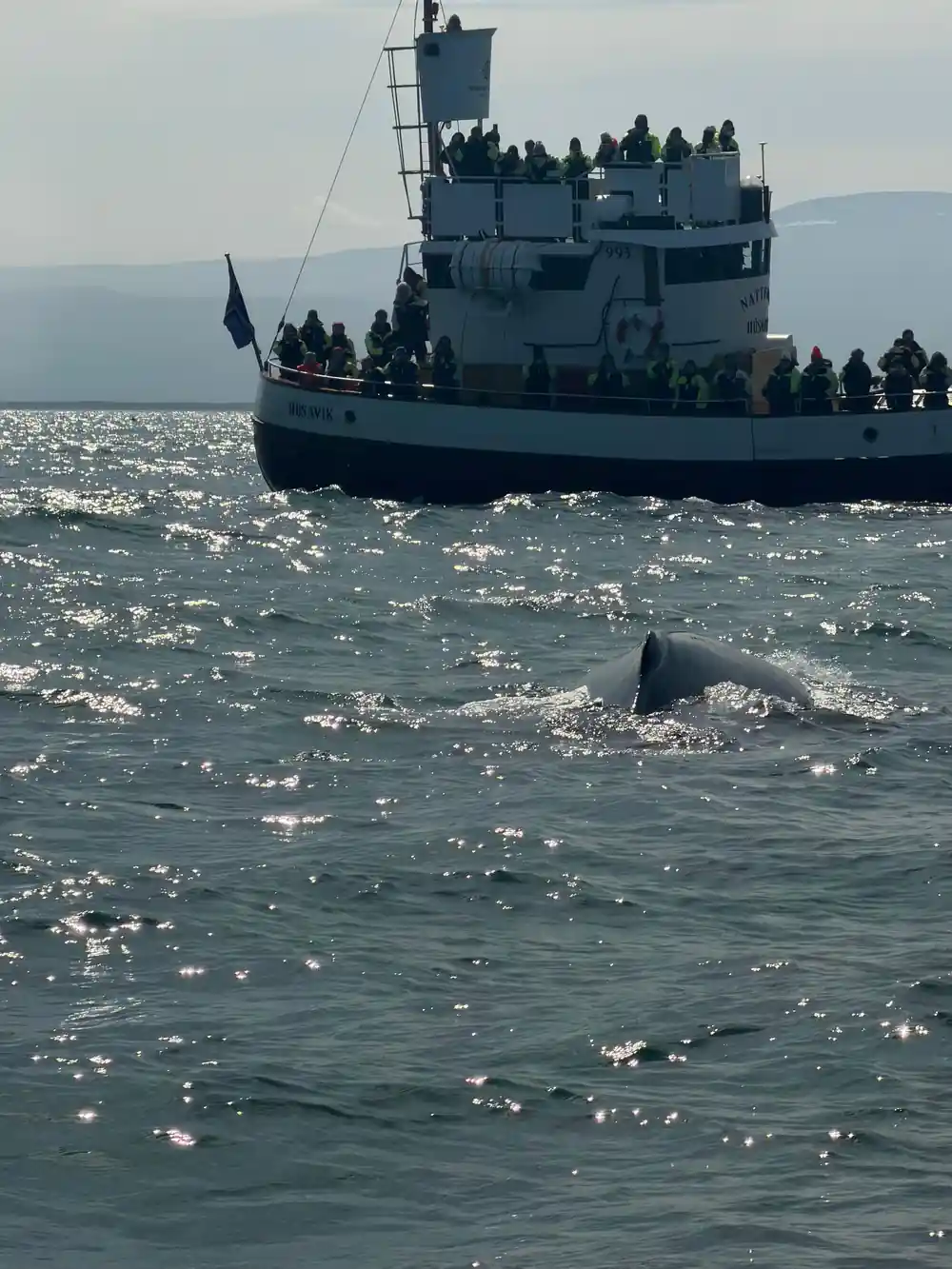
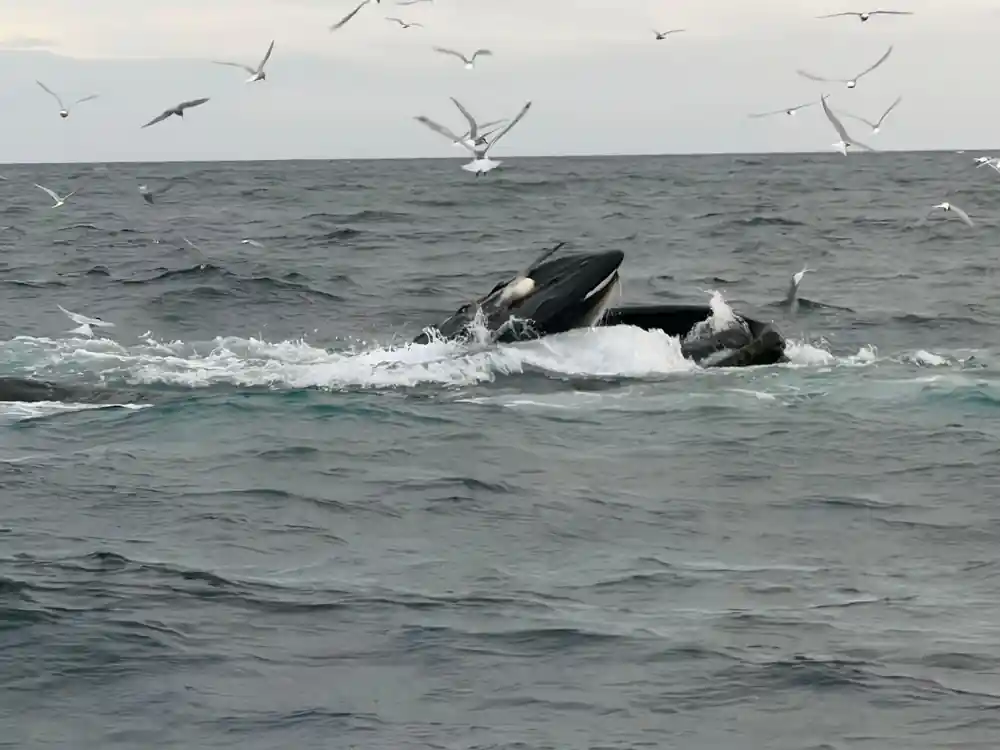
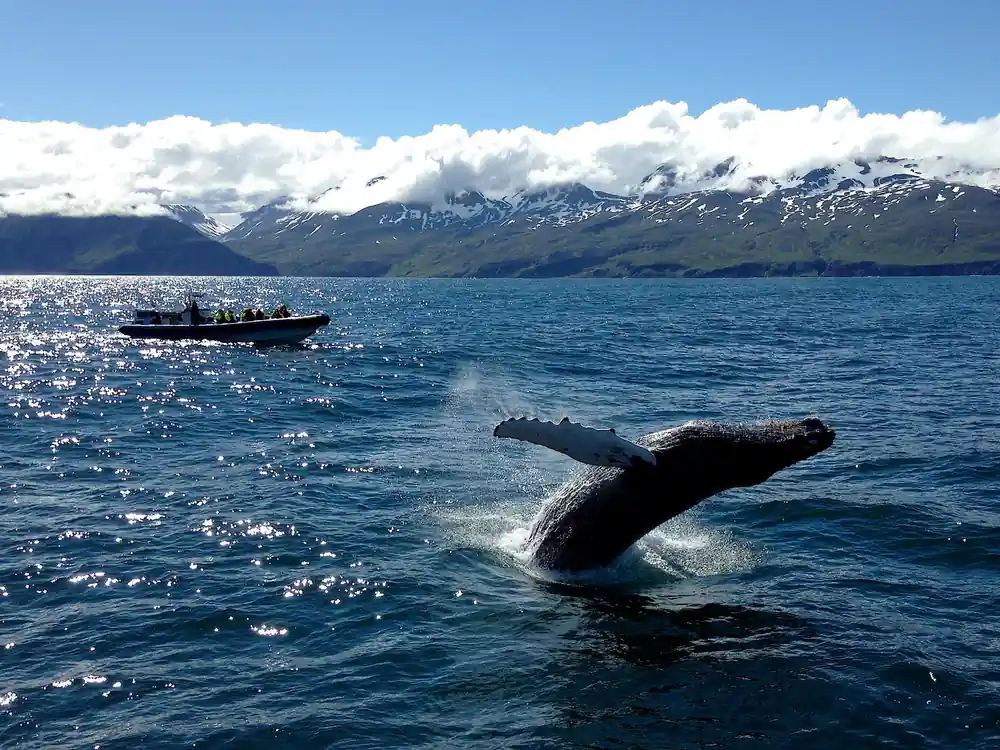
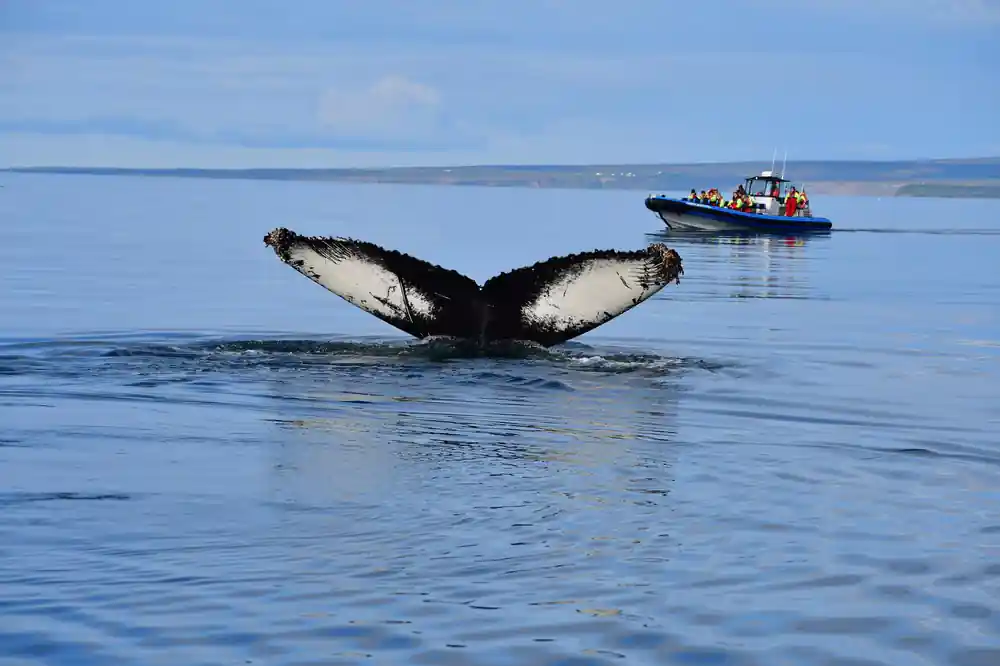
The fluke is the giveaway. When a humpback dives deep it lifts its tail clear of the water, and the trailing edge and the white pattern underneath are as individual as a fingerprint, which is how researchers keep track of named whales over years. In the bay, humpbacks often feed in company. Watch for a ring of bubbles breaking on the surface, then a row of open mouths lunging up through it: bubble-net feeding, where the whales herd fish into a tightening circle of air. It is sudden, loud and over in seconds, and it is worth keeping the camera up rather than watching through the screen.
Give a diving whale space and patience. A humpback that has lifted its fluke can stay under for several minutes and may come up well away from where it went down, so guides hold their distance and let the whale choose the encounter. A trip can feel slow and then very sudden. If the water goes quiet, look for birds gathering over one patch; where the birds work, the fish are, and the whales are rarely far behind.
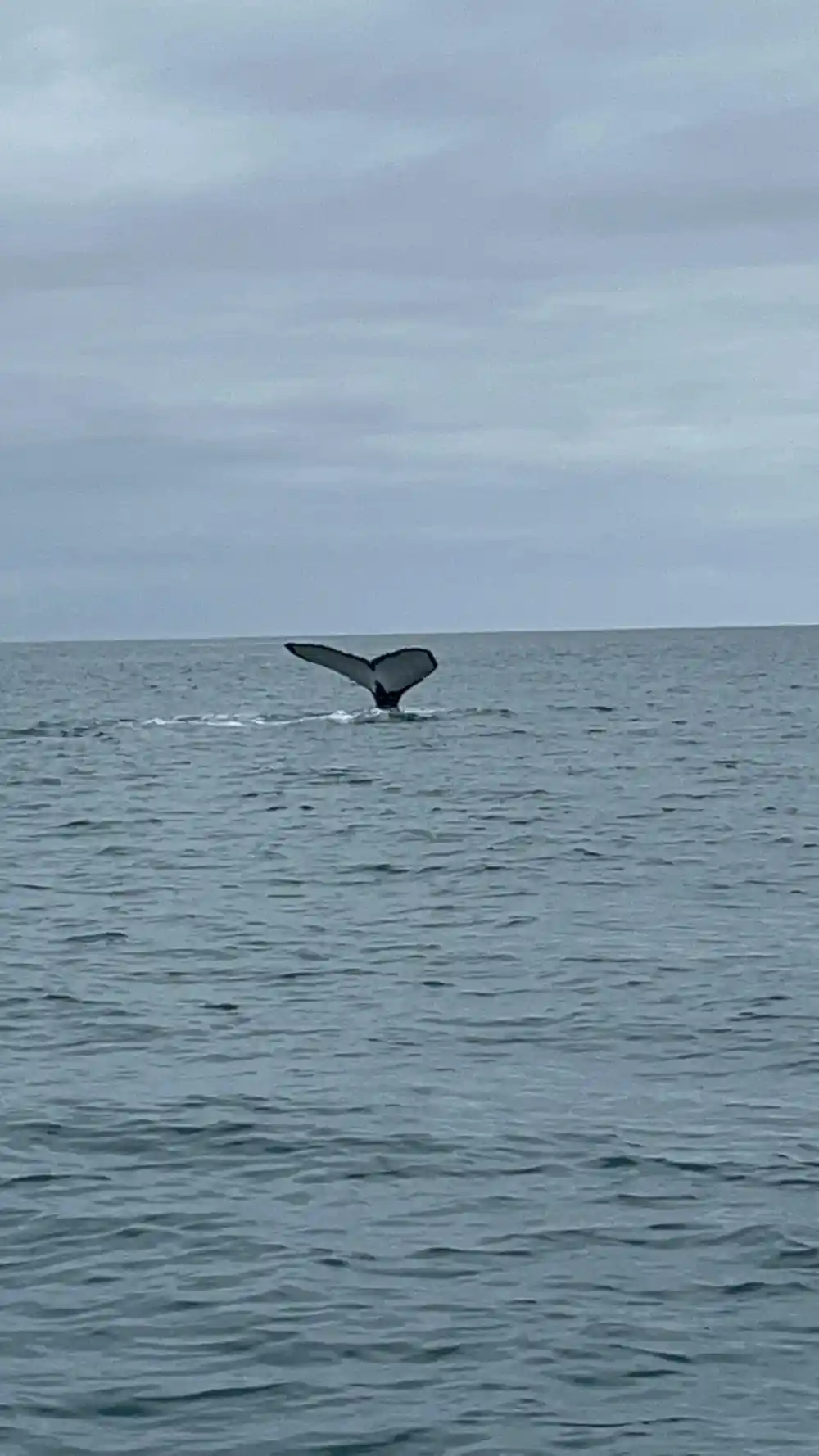
A humpback lifts its fluke before a long dive, giving watchers one last clear look.
Minke Whales: The Bay's Smallest Baleen Visitors
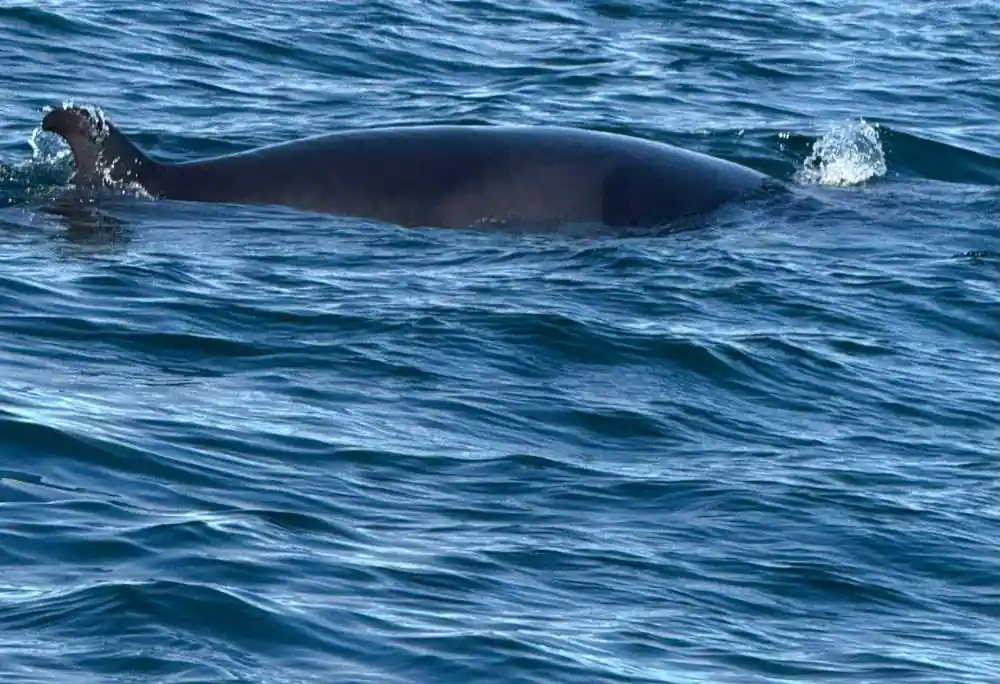
Minkes are the quiet regulars of Skjálfandi Bay. They are much smaller than humpbacks, sleek and pointed, with a tall curved dorsal fin and a snout that breaks the surface first. Minkes do not usually lift their tails, so you rarely get a long look: they roll, take a breath and are gone. The best clue is often the arched back and the patch of smooth water where the animal has just been.
They are also curious. Minkes sometimes change course to pass close to a stationary boat, and they move quickly enough to appear on one side and then the other. With no fluke to photograph, guides identify minkes by the fin, the pointed snout and the way they surface at speed rather than lying at the top. On a fast boat it pays to keep scanning the whole bay instead of fixing on the last place you saw a blow.
White-Beaked Dolphins and Occasional Orcas
White-beaked dolphins are the acrobats. They travel in groups, they often bow-ride, and they will leap clear of the water for reasons of their own. The name comes from the pale beak and the light markings along the flanks. When a pod finds the boat, the ride changes completely: dolphins on both sides, water breaking, everybody pointing at once. If you have booked a whale watching and dolphin cruise, this is usually the part people remember afterwards.
Can you see orcas in Húsavík? They are possible but never dependable. Orcas follow fish around Icelandic waters, and northern sightings tend to come in short runs when the fish are in. No operator can schedule them, and a 97% overall sighting rate does not promise orcas specifically.[1] If one does appear, the tall black dorsal fin is unmistakable, and the guide will usually call it long before you pick it out yourself.
97%
North Sailing reports an overall whale sighting success rate of 97% on its Húsavík tours, based on sightings in Skjálfandi Bay since 1995.[1]
Harbour Porpoises and the Complete Picture
Harbour porpoises are the little ones, and the easiest to overlook. They are dark, round-backed and shy, with a low triangular fin, and they surface in a quick rolling motion that barely disturbs the water. People often mistake the first sighting for a wave. In calm weather you can hear the puff of the blow before you see the animal, and then it has gone under again.
Put them together and you get the full picture of a bay that is busy at every size: porpoises, dolphins, minkes and humpbacks, with the chance of something bigger and rarer. Whale watching from Húsavík is not a single-species hunt. It is a couple of hours on cold water with your eyes open, and the mix is different every time. The whales decide the itinerary; the boat only gets you there.
Blue Whales: The Rarest Giants of the Bay
Some summers bring something else entirely. Blue whales pass through Icelandic waters in early summer, and Skjálfandi Bay is one of the places where they have been seen from Húsavík. A blue whale is long and grey-blue, with a small dorsal fin set far back, and its blow is a tall, straight column you can spot from a long way off. The blow is usually the clue, not the body.
Sightings are sporadic. Some years they show up, some years they do not, and no guide can promise one. A speedboat helps here. A fast hull covers more of the bay inside one departure, and the Original Big Whale Safari & Puffins by Speedboat takes 2 hours and runs from Husavik to Puffin Island and into Skjálfandi.[2] The same route passes close to the puffin colony, which is a nesting ground for around 36,500 active breeding pairs of puffins.[13] Slow boats and fast boats work the same water, and on a rare-whale day the extra ground is worth having.
How Guides Identify Whales and Read Their Behaviour
Guides work from small clues. A short, bushy blow suggests a minke; a tall column that hangs in the air suggests something bigger. A dark back rolling forward with no fin showing is often a porpoise, while a fin cutting a straight line with dolphins leaping around it is a pod on the move. Photographs of flukes and fins go into catalogues, so a whale photographed in Skjálfandi Bay one summer can be recognised in another.
Behaviour is the other half of the reading. Feeding whales change direction unpredictably; travelling whales hold a steady course. A whale that has just dived deeply may stay under for minutes, so guides plan a loop rather than chasing the animal down. From land the same logic applies, and The Whale Trail advises that one of the best ways to find marine mammals is to look for other people who are watching them, especially stopped boats.[14] The harbour mouth and the headland above the baths are good places to try that.
On the water, a fast hull is a useful tool. The RIB Express boat has a comfortable cruising speed of 32 knots.[15] Speed does not make whales appear, but it lets a guide check several feeding areas in one departure and still leave time to drift quietly alongside an animal that decides to stay. Afterwards, the GeoSea Geothermal Sea Baths sit just outside town, with seawater from geothermal boreholes kept at 38 to 39 °C year-round.[3]
From prices for Húsavík whale tours
Every value is the from price on a Húsavík tour listing: US$85[16], US$98[17], US$99[5], US$164[4] and US$171[2].
What a Húsavík whale trip costs
Amounts are the from prices per person on each Húsavík listing: US$171[2], US$164[4], US$99[5] and US$85[16]. Separate child rates are not published there.
When to book a Húsavík whale trip
Plan your whale day
Decide what you want to see
Humpbacks, minkes, dolphins and porpoises are the regulars, while orcas and blue whales are never guaranteed. Pick a boat that suits your stomach and your timetable.
Book the first departure
Morning water is often calm and the light is clean for photographs. In high summer, late trips come home in bright daylight.
Dress for the bay
Warm layers, a windproof jacket, hat and gloves. It is much colder on the water than at the harbour, and spray from a RIB adds to the chill.
Keep watching everywhere
Sweep the whole bay, not just the wake. Watch for blows, feeding birds and stopped boats, which often mark a whale somebody else has already found.
Warm up afterwards
GeoSea Geothermal Sea Baths sits outside town with seawater from geothermal boreholes kept at 38 to 39 °C year-round.[3]
Visit the Whale Museum
Founded in 1997 to give detailed information about whales and their habitat, it pairs well with a boat trip on a wet day.[18]
Ready to meet the whales of Skjálfandi Bay?
from US$172Reserve now & pay later