The short answer
- The boats leave from Húsavík. Akureyri and Reykjavík are places to sleep and travel from, not harbours for this particular bay.
- Top choice Original Big Whale Safari from US$171 Duration2 hours[1]Rating4.73 from 1,423 reviews[1]GuideEnglish live guide[1]CancellationFree cancellation up to 24 hours before[1] Check availability
- Whale Watching with Guide from US$99 Duration3 hours[2]Rating4.63 from 2,958 reviews[2]GuideEnglish live guide[2]CancellationFree cancellation up to 24 hours before[2] See this tour
- Big Whales and Puffins from US$164 Duration2 hours[3]Rating4.83 from 1,059 reviews[3]GuideEnglish live guide[3]CancellationFree cancellation up to 24 hours before[3] See this tour
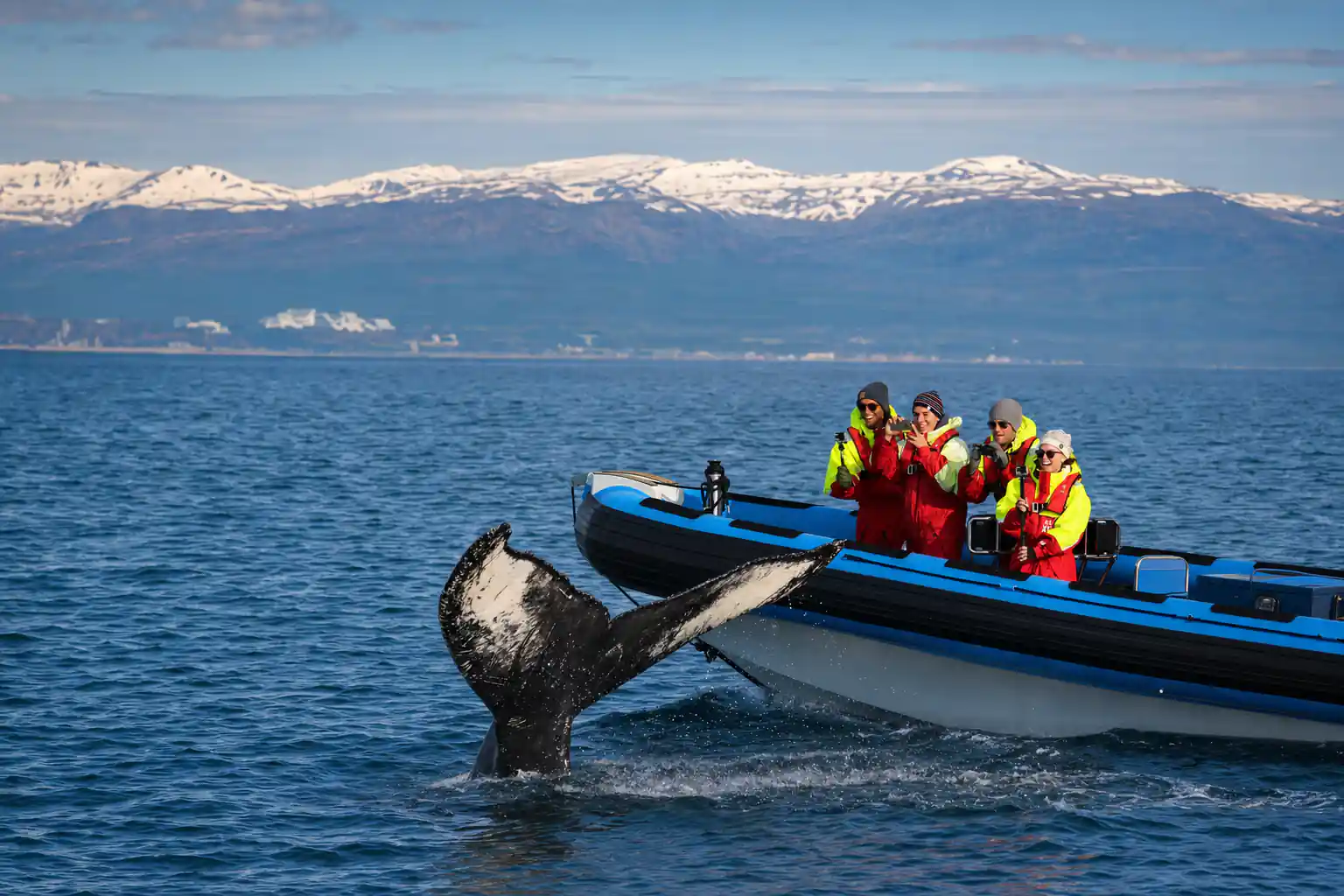
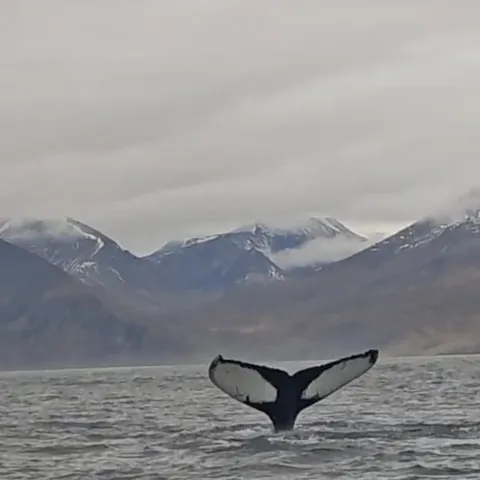
To provide realistic expectations to spot whales, we have gathered data of sightings in Skjálfandi Bay from every tour since the beginning of whale watching in 1995 in Húsavík. The results are truly impressive, with a 97% success rate of overall sightings!
Verdict: sleep in Húsavík for the boats
Things to check
On the day
- Skjálfandi Bay averages 8.8 C in summer, so dress warmer than the air suggests.[4]
- From May through August the sun never fully sets, so late trips end in daylight.[5]
- Book ahead for the peak weeks from June through August.[6]
- Look for stopped boats and the people watching them, from shore or from the deck.[7]
Why the boats leave from Húsavík
Whale watching in Iceland did not begin in the capital. Commercial whale watching in Iceland began in Húsavík in 1995[8], and the harbour has been the heart of it ever since. The boats tie up in the middle of town, a short walk from the guesthouses and the church, and Skjálfandi Bay opens up in front of the pier. You are on the water within minutes of casting off, with no long transfer before the trip begins.
The town itself is small, with a population of roughly 2,500[6], and that is a large part of the appeal. You can walk to the dock, come back for lunch, and go out again. The bay is about 28 kilometers wide at its widest point and about 25 kilometers long[9], so there is plenty of water for the skippers to search when the whales are moving.
Húsavík runs its whale watching season from April to October, with peak sightings June through August[6]. In midsummer the harbour fills up early and the town feels busy, so book ahead if you are travelling in those weeks. Outside the season it goes quiet, and the whale museum and the geothermal baths become the main reasons to stop.
What you see out in the bay
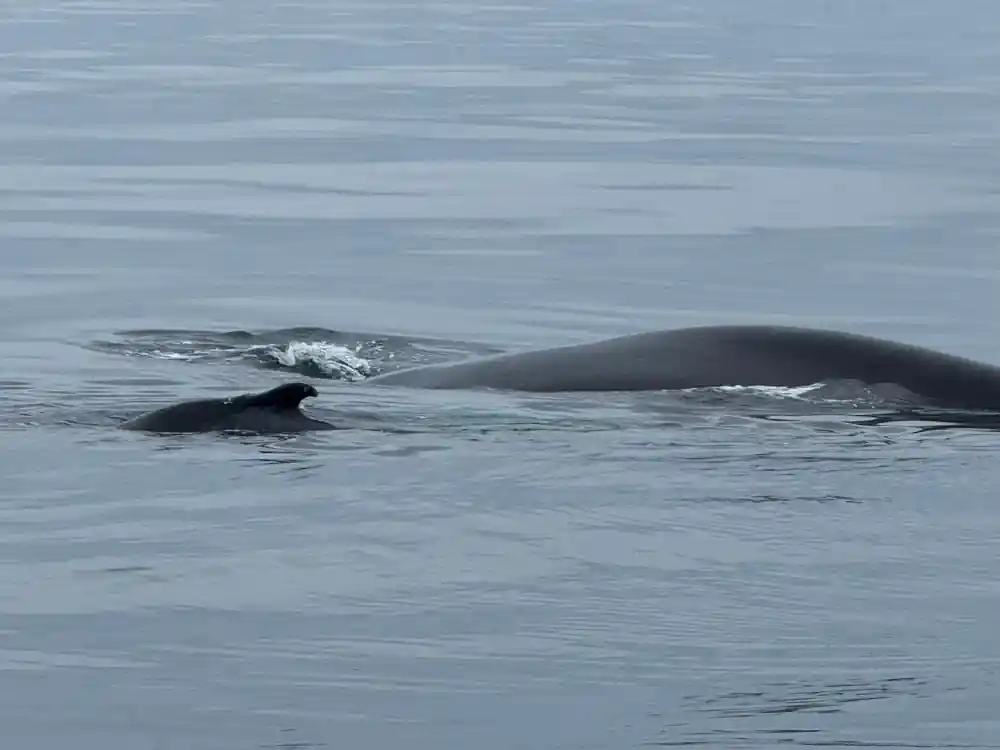
Whales appear here often enough that the operators publish their numbers. North Sailing says its Húsavík whale watching tours have had a 97% overall whale sighting success rate, based on sightings in Skjálfandi Bay since 1995[10]. That figure covers overall sightings rather than any single species or season, so read it as a guide to the odds rather than a promise about your particular morning.
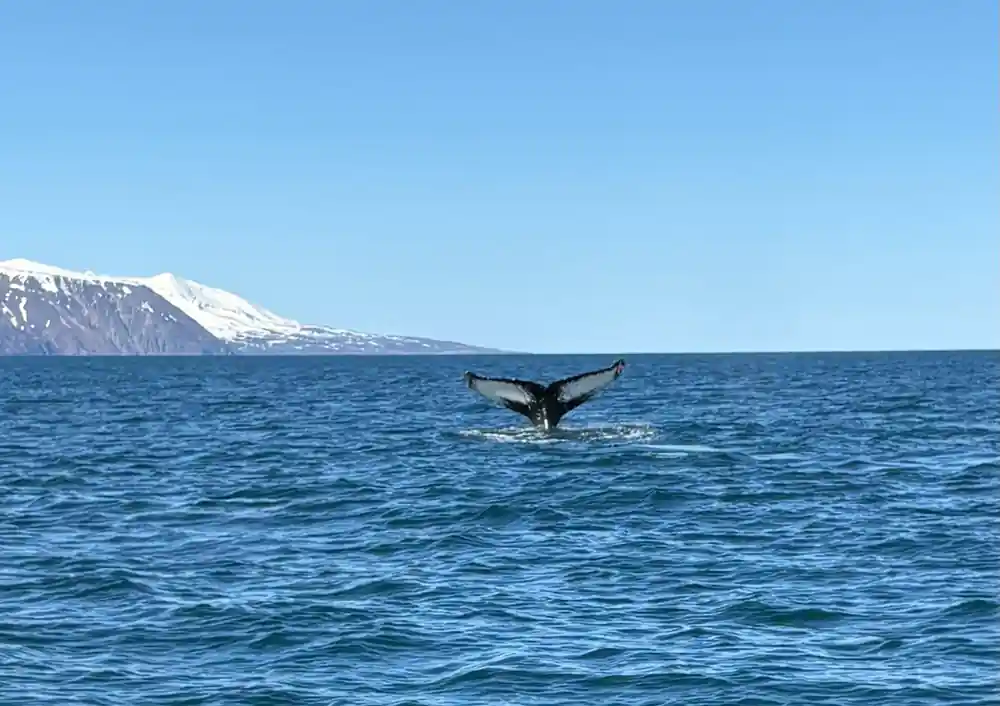
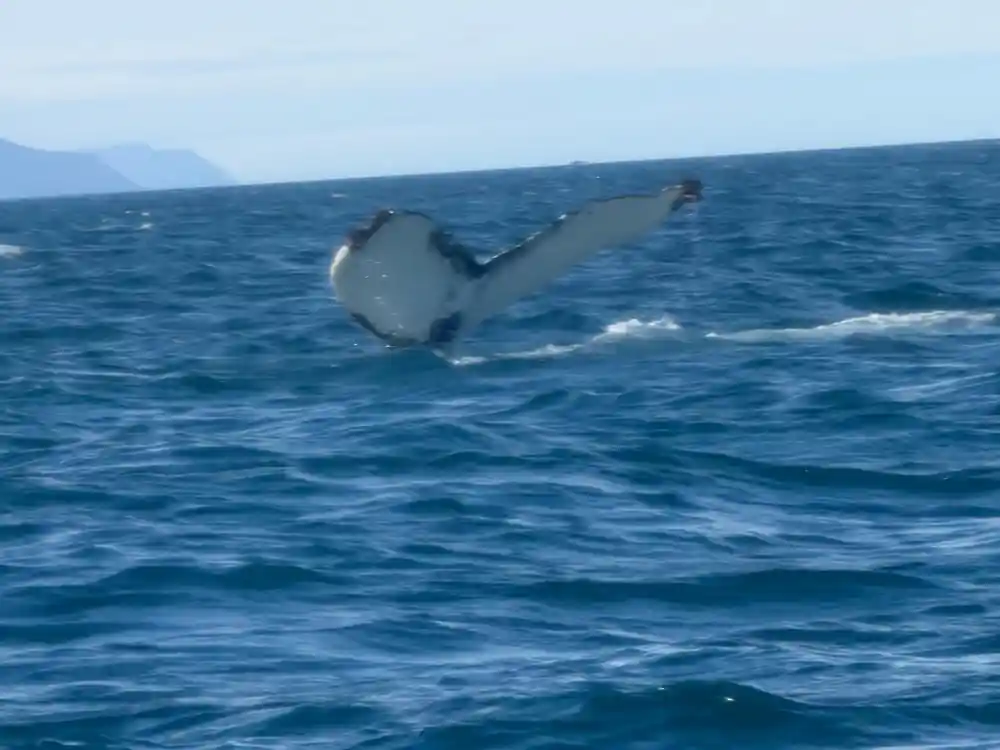
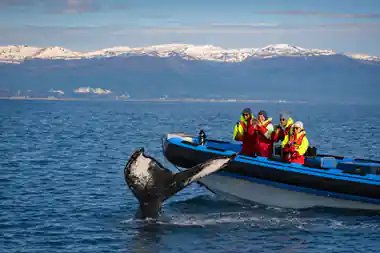
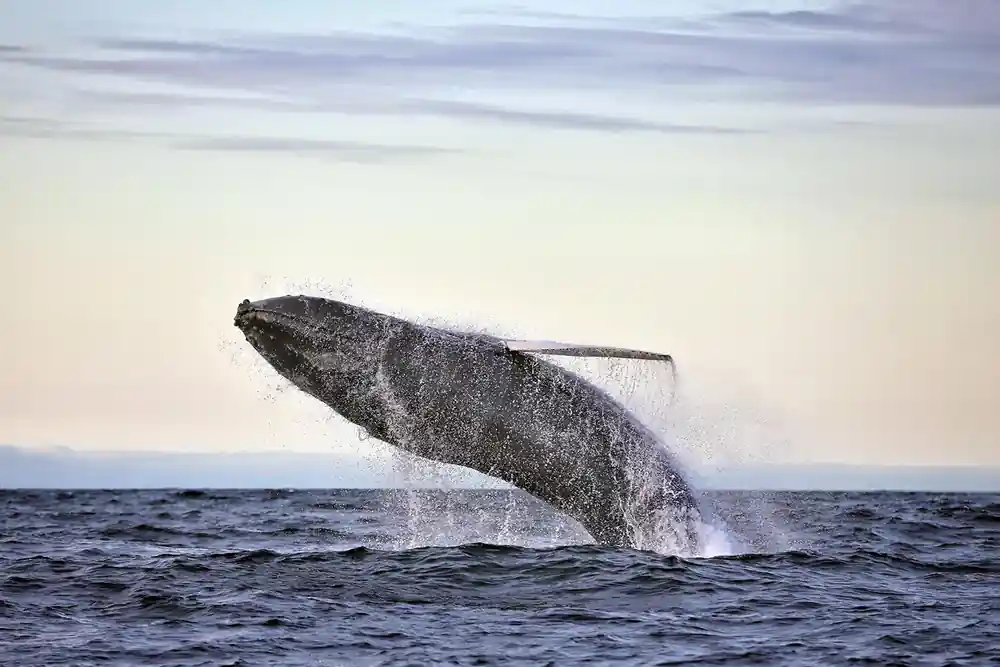
On North Sailing tours there is a chance to encounter up to 11 different cetacean species[10], from the humpbacks everyone hopes for to dolphins and porpoises. Humpbacks are big animals: Northern Hemisphere humpbacks average 49 to 52 feet long, and a mature adult weighs 50,000 to 80,000 pounds[11]. A fluke lifting clear of the water beside an open boat, then sliding under, is the moment most people remember.
Puffins are the second act. The puffin island in Skjálfandi Bay is described as a nesting ground for around 36,500 active breeding pairs[12]. They are small, fast and funny in flight, and the boats get close enough to watch them standing about on the rocks with their beaks full.
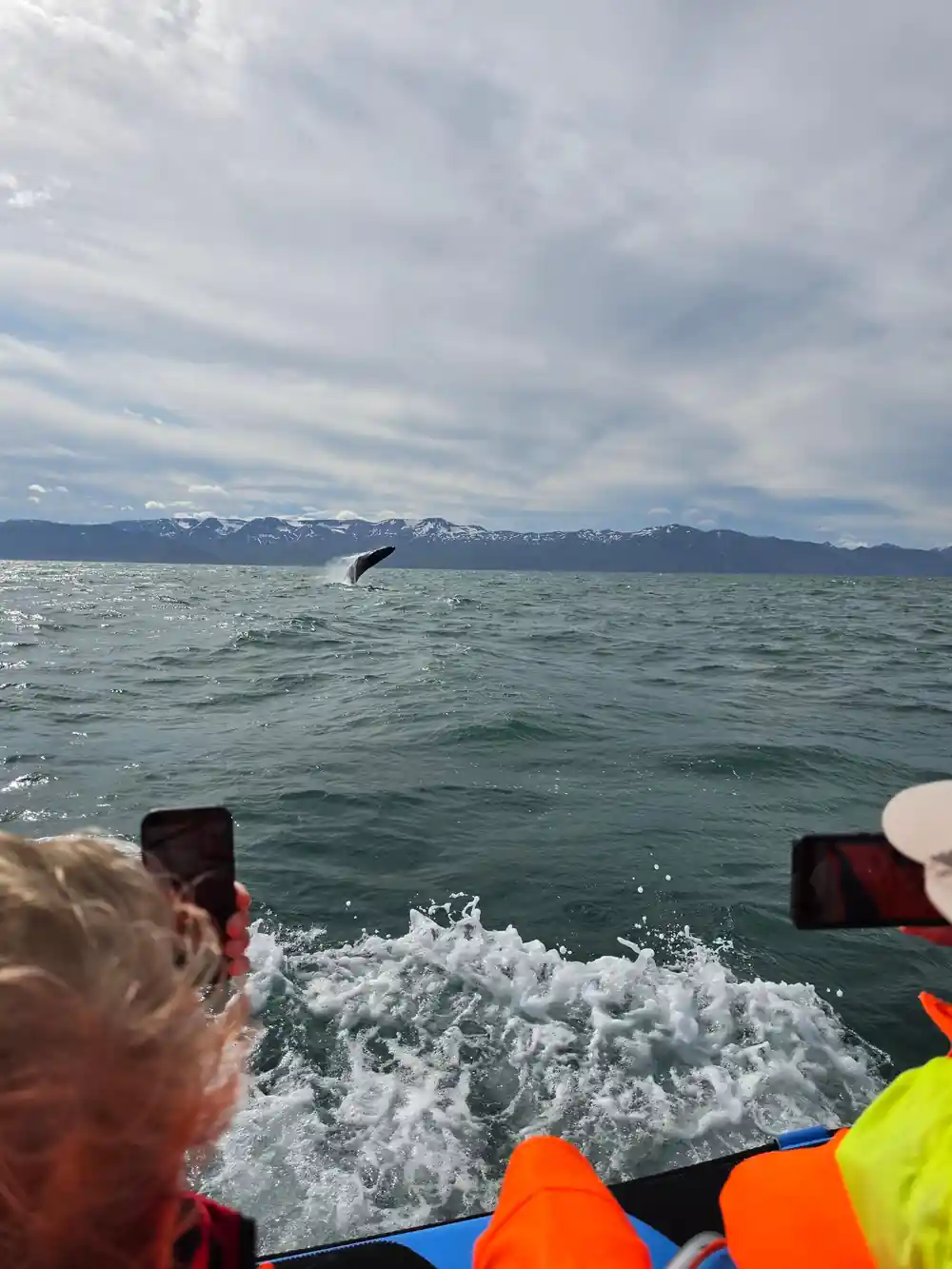
Skjálfandi Bay opens straight out from Húsavík harbour, with the puffin island and the mountains beyond.
Húsavík as a base: walking to the boat
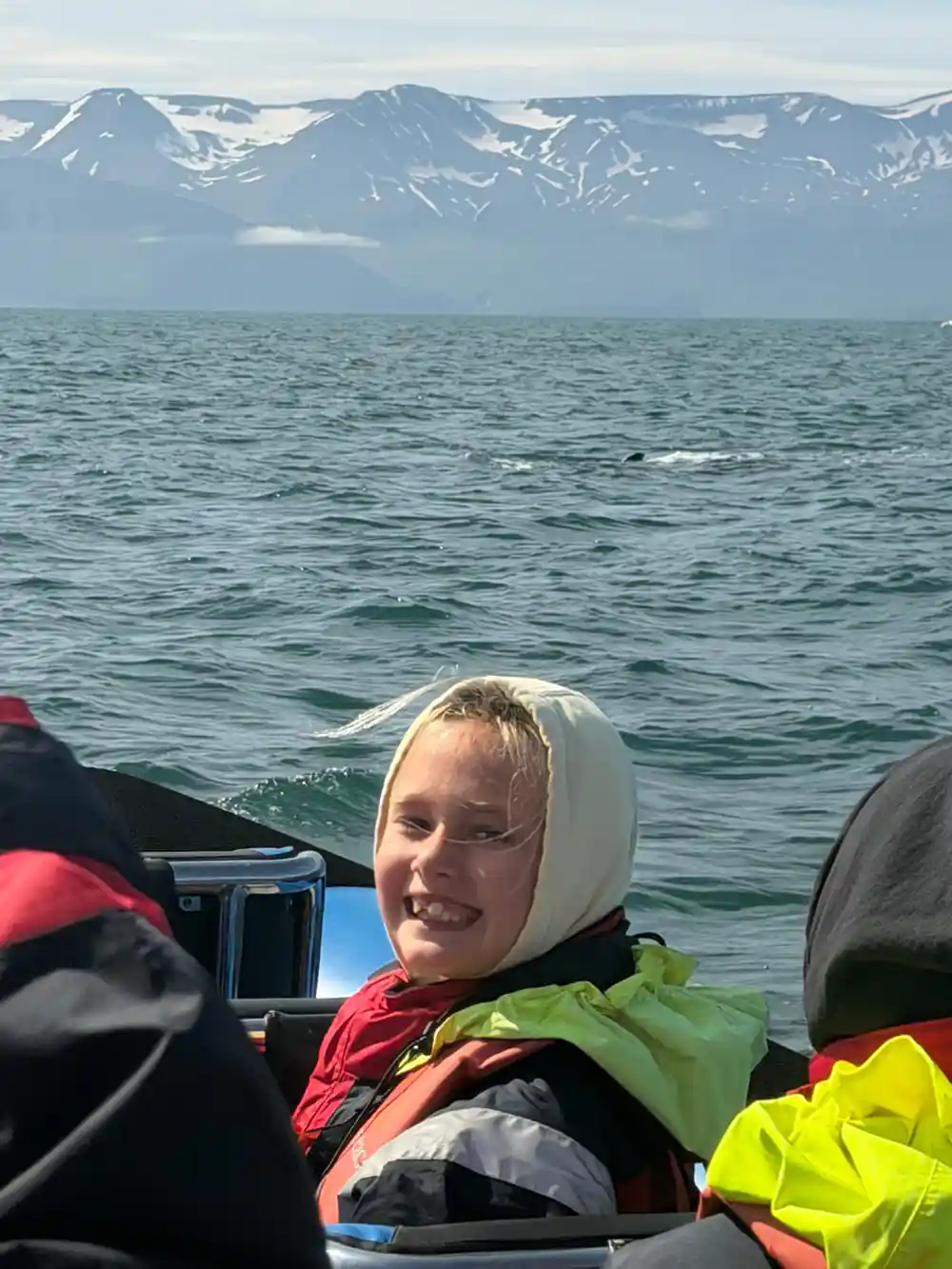
If the whale trip is the whole reason you came north, staying in Húsavík takes the stress out of it. You get up, walk to the harbour, pull on the overalls, and you are out in the bay without touching a car. When you come back, cold and hungry, your room is a few minutes away and the coffee is on.
There is enough in town to fill the rest of a day. The Húsavík Whale Museum was founded in 1997, and its main aim is to give detailed and interesting information about whales and their habitat[13], which makes it a good warm-up before a boat trip or a good debrief after one. Museum tickets are not bookable through this site, so check the museum's own opening hours before you plan around it.
Beyond the harbour, the GeoSea geothermal sea baths sit on the cliff at Húsavíkurhöfði, just outside town, with infinity pools filled with seawater from geothermal boreholes kept at 38 to 39 °C year round[14]. After a couple of hours in an open boat, that is a very good place to be.
Akureyri as a base: what changes
Akureyri is the other northern option, and it is a town rather than a village, with shops, restaurants, a swimming pool and its own harbour on Eyjafjörður. It is a comfortable place to spend a couple of nights, and it gives you somewhere to eat and wander once the boat day is over.
The difference shows in the morning. Basing in Akureyri turns the whale trip into a day out: you drive over to Húsavík, join your boat, and drive back afterwards. That suits travellers who are already working their way around the north and would rather sleep somewhere with more choice in the evening than a small harbour town.
The trade-off is the weather call. You make the drive first and hope the sea allows the trip, and if conditions change you have spent the travel time anyway. Sleeping in Húsavík the night before removes that gamble and puts you at the dock for the earliest departure, when the bay is often at its calmest.
from US$85
A family-run Húsavík boat with indoor seats, a good choice when the wind is up or you have children aboard.[16]
Reykjavík as a base: what changes
If you are weighing up Husavik or Reykjavik for whale watching, the geography settles it. Reykjavík sits in the south-west of Iceland and Skjálfandi Bay is in the north, so a Húsavík boat trip is not really a day out from the capital. The drive is doable on a long summer day, but you will spend far more of it behind the wheel than on the water.
The practical answer is to give the north a night. Drive up, sleep in or near Húsavík, take a boat in the morning, and use the afternoon for the whale museum, the geothermal baths or a walk along the harbour. Then carry on around the north or head back south the next day.
The long northern daylight makes that easier. In Iceland the midnight sun peaks around the summer solstice in June, and the sun never fully sets from May through August, so the nights stay bright right across the island[5]. Late departures still come back in daylight, and an evening drive north does not mean driving in the dark.
Speedboat or big boat: choosing your tour
The Húsavík tours split into two types. The speedboat safaris are open RIB-style boats that run 2 hours[1], and several of the larger boats run 3 hours[2]. They work the same water: the routes go out from the harbour, past Puffin Island and into Skjálfandi Bay.[1]
Speed buys you distance. The RIB Express, a boat of this type, has a comfortable cruising speed of 32 knots[15], quick enough to reach the feeding grounds and still leave time for watching. Expect a bouncier, wetter, colder ride than on a bigger boat, and hold on when you stand up.
Prices follow the same pattern. The Original Big Whale Safari and Puffins by speedboat starts from US$171[1] and the Big Whales and Puffin Island speedboat tour from US$164[3], while the larger boats start from US$99[2] and from US$85[16]. Choose the open boat for puffins and reach, or the bigger boat for shelter, seats and a slower pace.
Weather, season and what to wear
The season runs from April to October, with peak sightings June through August[6]. Summer is as warm as the water gets: the average sea water temperature in Skjálfandi Bay rises to 8.8 C in summer[4]. That is still cold enough to sting if you trail a hand over the side, so keep it in your sleeve.
Layers do the work. A windproof shell over a fleece, a hat, gloves, sunglasses and shoes with grip will keep you comfortable on an open boat, and a dry bag keeps your phone alive through the spray. Sunscreen is worth packing as well, since the light off the water is strong even when the air is cool.
Two habits help. Take seasickness tablets before you leave the harbour if you are prone to it, and sit outside in the fresh air rather than in a cabin. If your plans change instead of the weather, the Húsavík whale watching listings offer free cancellation up to 24 hours in advance for a full refund[1], and reserve now and pay later is offered on the same listings.
From-prices for Húsavík whale watching tours
From-prices in US dollars from GetYourGuide listings for Húsavík whale watching.[1][2][3][16][17]
What each Húsavík boat costs from
From-prices in US dollars from GetYourGuide listings[1][2][3][16]
When to book your Húsavík whale trip
Planning your whale trip
Choose your base
Húsavík, Akureyri or Reykjavík, depending on whether you want to walk to the boat or drive to it.
Pick the boat
An open speedboat for puffins and distance, or a larger boat for shelter and a slower pace on the water.
Book it
Speedboat and puffin trips fill up, and the Húsavík listings offer free cancellation up to 24 hours in advance.[1]
Dress for the sea
Bring a warm hat, gloves and a windproof layer, and wear flat shoes; open boats get cold and spray can soak you.
Fill the rest of the day
Add the whale museum, the geothermal sea baths or a slow walk along the harbour while you are in town.
See humpbacks and puffins from Húsavík harbour
from US$172Reserve now & pay later