The essentials
- One-piece suits with built-in buoyancy keep wind, spray and cold water off your clothes. Wear thin warm layers underneath and check the fit at the collar and cuffs.
- Where to sit, how to hold on and what to do if something goes wrong. Ask the crew about anything that is not clear before the boat leaves the dock.
- The RIB Express boat has a comfortable cruising speed of 32 knots, and your guide speaks English throughout the trip.[1][2]
- Tell the crew at check-in if motion affects you, take your usual medication well before departure, and keep your eyes on the horizon on the fast stretches.
- The speedboat safari is from US$171, rated 4.73 from 1,423 reviews, with free cancellation up to 24 hours in advance for a full refund.[2]
- Top choice Original Big Whale Safari from US$171 Duration2 hours[2]Rating4.73 from 1,423 reviews[2]RouteHusavik, Puffin Island, Skjálfandi[2]GuideLive tour guide, English[2]CancellationFree cancellation up to 24 hours[2] Check availability
- Big Whales & Puffin Island from US$164 Duration2 hours[3]Rating4.83 from 1,059 reviews[3]RouteHusavik, Puffin Island, Skjálfandi[3]GuideLive tour guide, English[3]CancellationFree cancellation up to 24 hours[3] See this tour
- Family-Run Whale Watching from US$85 Duration3 hours[4]Rating4.70 from 1,987 reviews[4]RouteSkjálfandi[4]GuideLive tour guide, English[4]CancellationFree cancellation up to 24 hours[4] See this tour
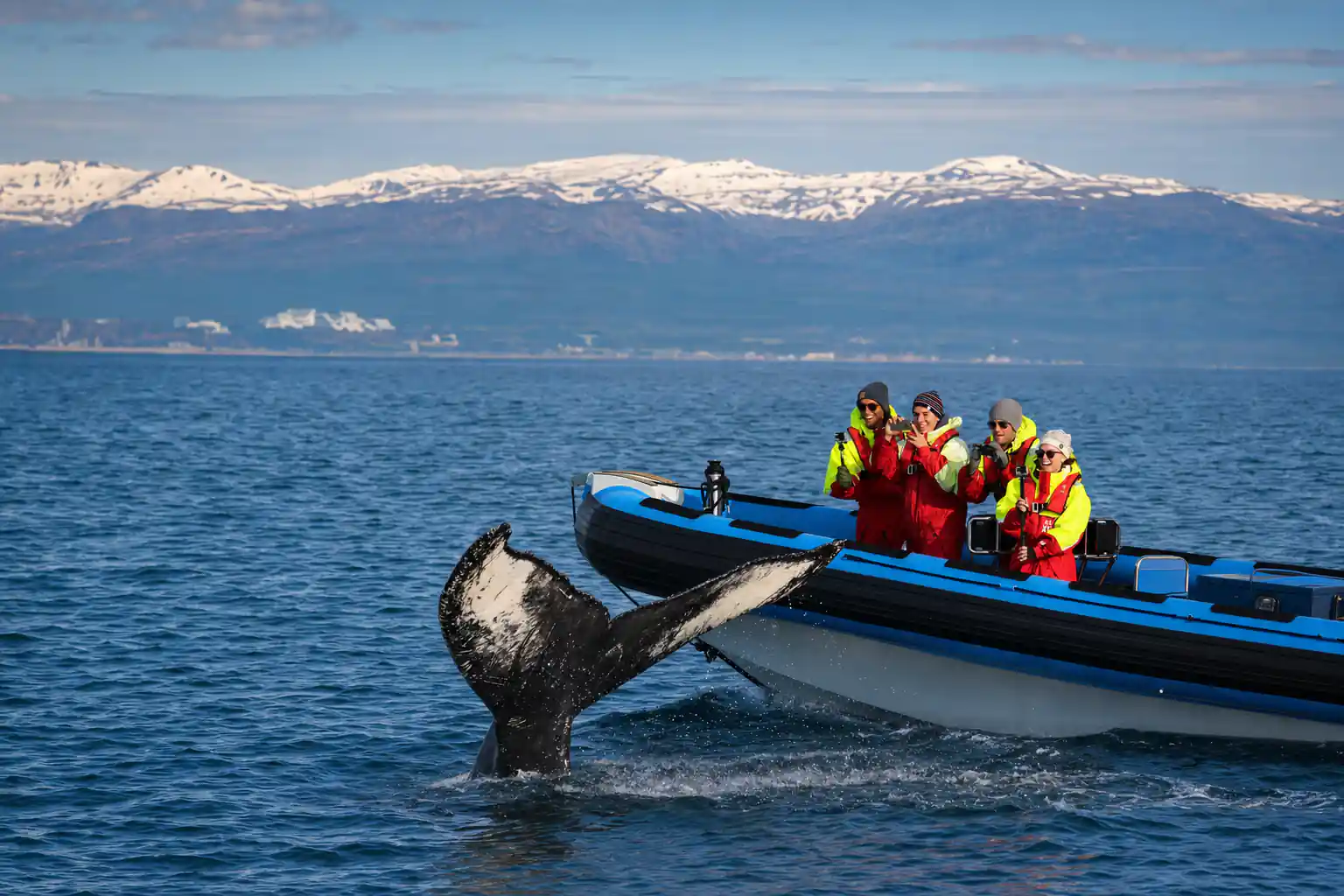
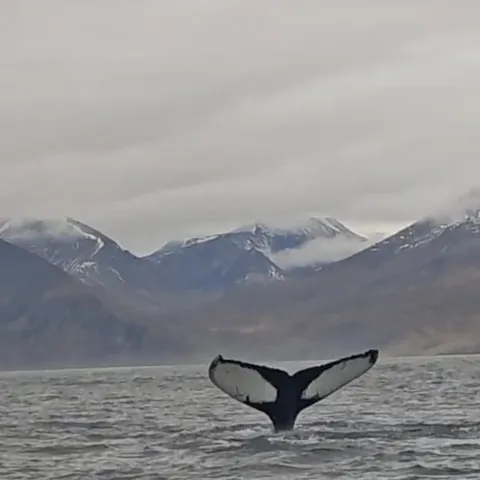
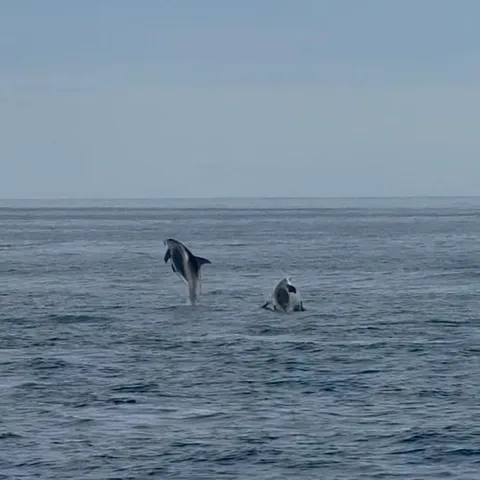
we have a comfortable cruising speed of 32 knots so we have plenty of time out in the whales’ feeding grounds.
Our verdict: a short, fast, well guided Húsavík safari
Before you board
- Read the safety board at the dock and ask the crew anything that is not clear
- Check your flotation suit fits at the collar and cuffs, and ask for another size if not
- Tell the guide if you cannot swim, if you are pregnant, or if motion sickness affects you
- Take a hat that stays on, thin gloves and sunglasses with a strap
On the water
- The speedboat safari lasts 2 hours, so plan the rest of your day around it[2]
- Summer sea water in the bay averages 8.8 C, so keep hands and face covered[5]
- Tell the guide early if you feel cold, sick or frightened, rather than waiting it out
- Free cancellation up to 24 hours in advance for a full refund[2]
The Safety Board Display at the Harbour and On Board
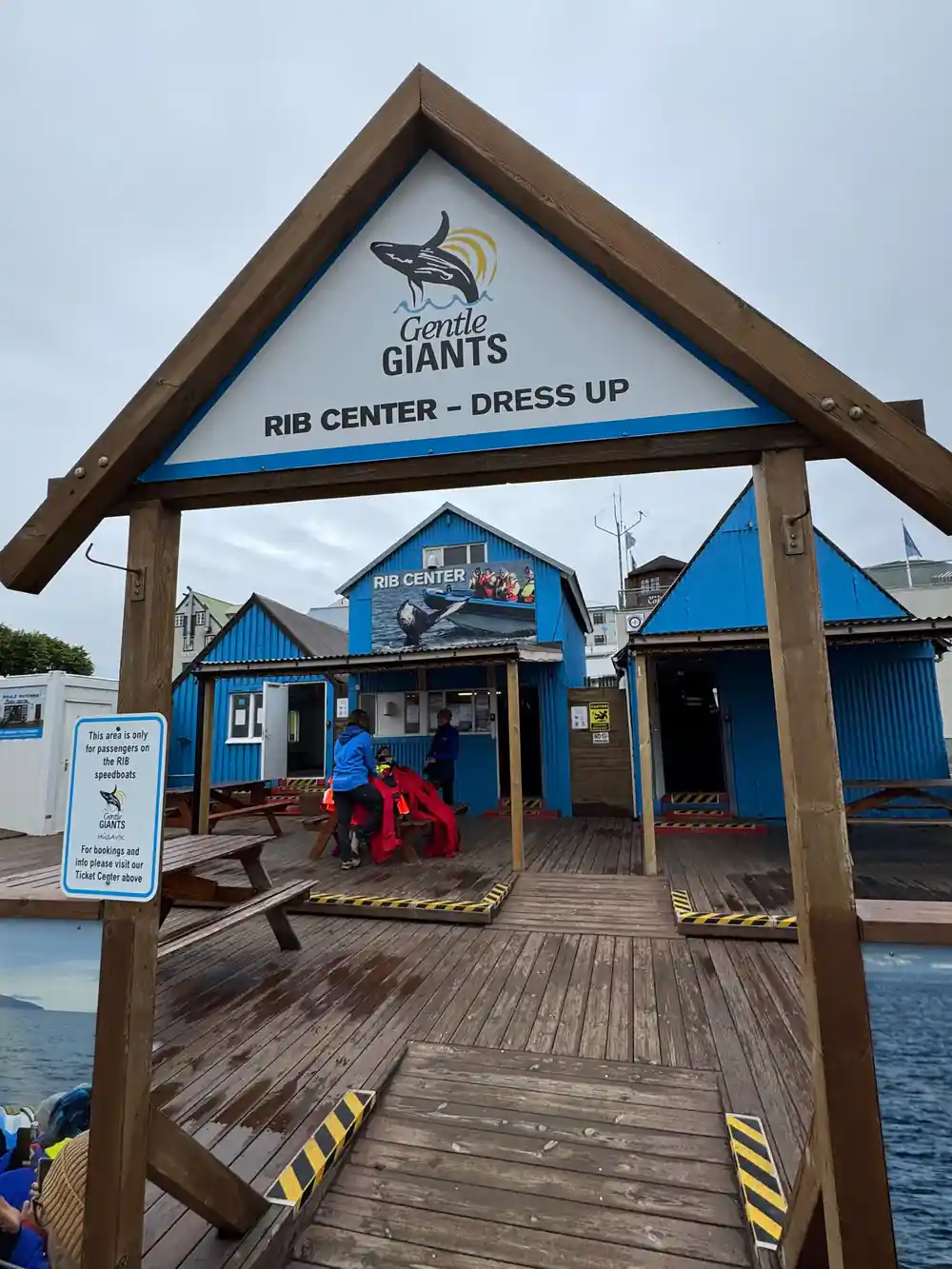
Húsavík is a working harbour town of roughly 2,500 people on Iceland's north coast, and everything connected with the boats sits within a short walk of the pier.[6] Before you check in, walk along the docks and look at the boats you will be going out on. Look as well for the safety board display: the panel, usually beside the ticket desk or at the boarding point, that sets out the important points in pictures and a few short lines. Reading it takes a minute and it makes the briefing on board far easier to follow.
Everyone on the speedboat safari has a live guide who speaks English, so you can ask anything you like in plain language.[2] Ask where to put your feet when the boat moves, how to hold the rail, how the fastenings on your suit work, and what the plan is if the sea turns choppy. Crews would far rather answer a small question at the dock than deal with a problem at sea, and nobody will think you are fussing.
It also helps to know the shape of the trip before you sit down. The speedboat safari lasts 2 hours and its stops run from Husavik out to Puffin Island and into Skjálfandi.[2] The fast, bouncy stretches come at the beginning and the end, with calmer time at the whale grounds in between, and simply knowing that makes the motion easier to ride.
Flotation Suits and What to Wear on the Water
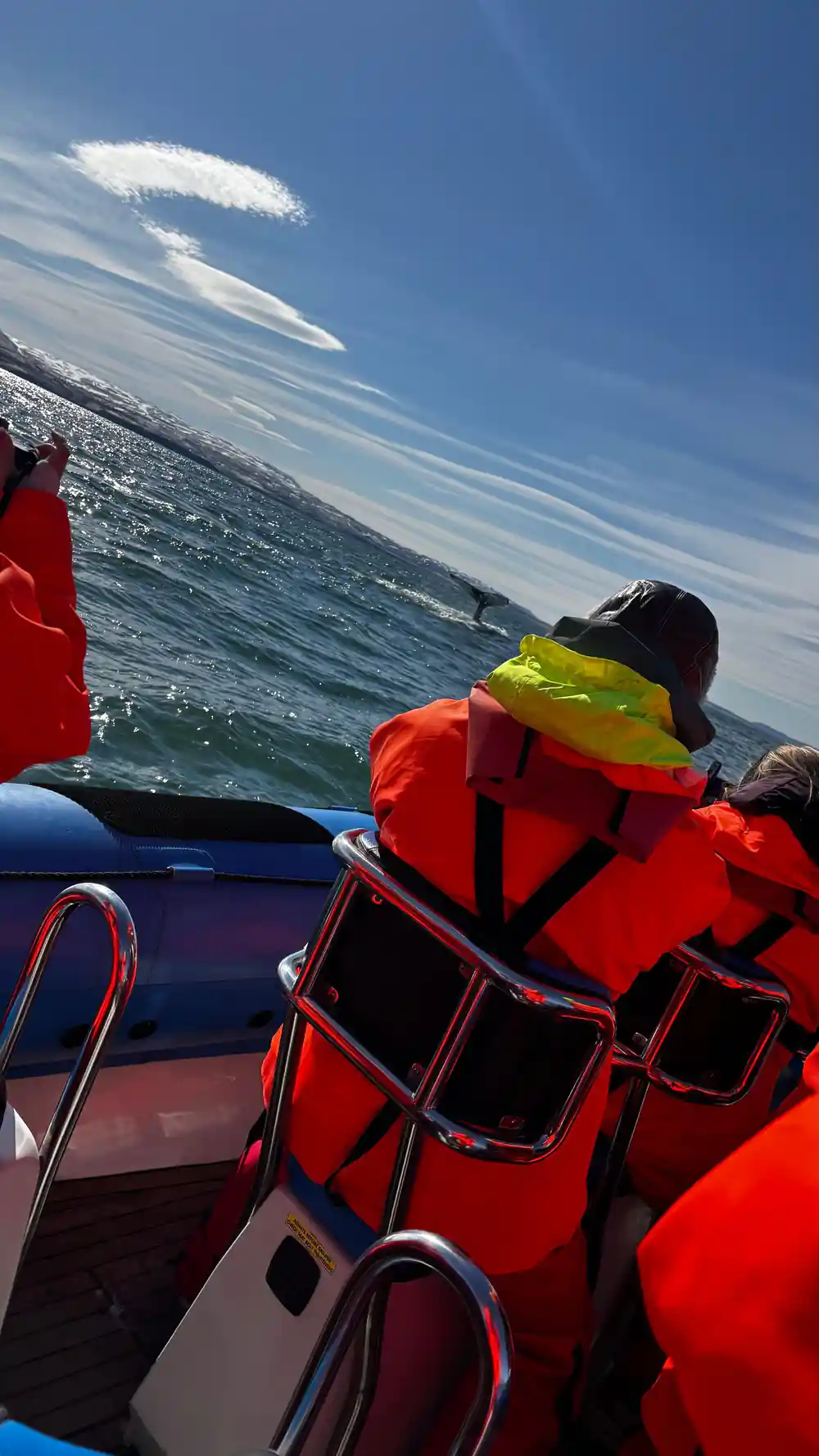
A flotation suit is a one-piece outer layer with built-in buoyancy. It keeps wind, spray and the first shock of cold water off your clothes, and it gives you something to float in if you end up in the sea. Underneath, wear thin warm layers rather than one thick coat, so the suit sits properly and you can still bend, sit and move around when the boat slows down.
Check the fit before the boat leaves. The collar should sit snug against your neck, the cuffs should meet your gloves, and you should be able to turn your head and squat without the suit pulling hard. If it feels wrong, say so and ask for another size. A suit that is too big fills with wind and flaps; one that is too tight is cold and awkward. If anything about the fastenings is not obvious, ask the crew to run through it with you.
Summer sea water in Skjálfandi Bay averages 8.8 C, so hands and faces feel the cold even on a bright, still day.[5] Take a hat that fits under a hood, thin gloves, and sunglasses with a strap. Keep phones and cameras in a zipped pocket or a dry bag, and stow anything loose before the boat picks up speed, because a camera that goes over the side is gone.
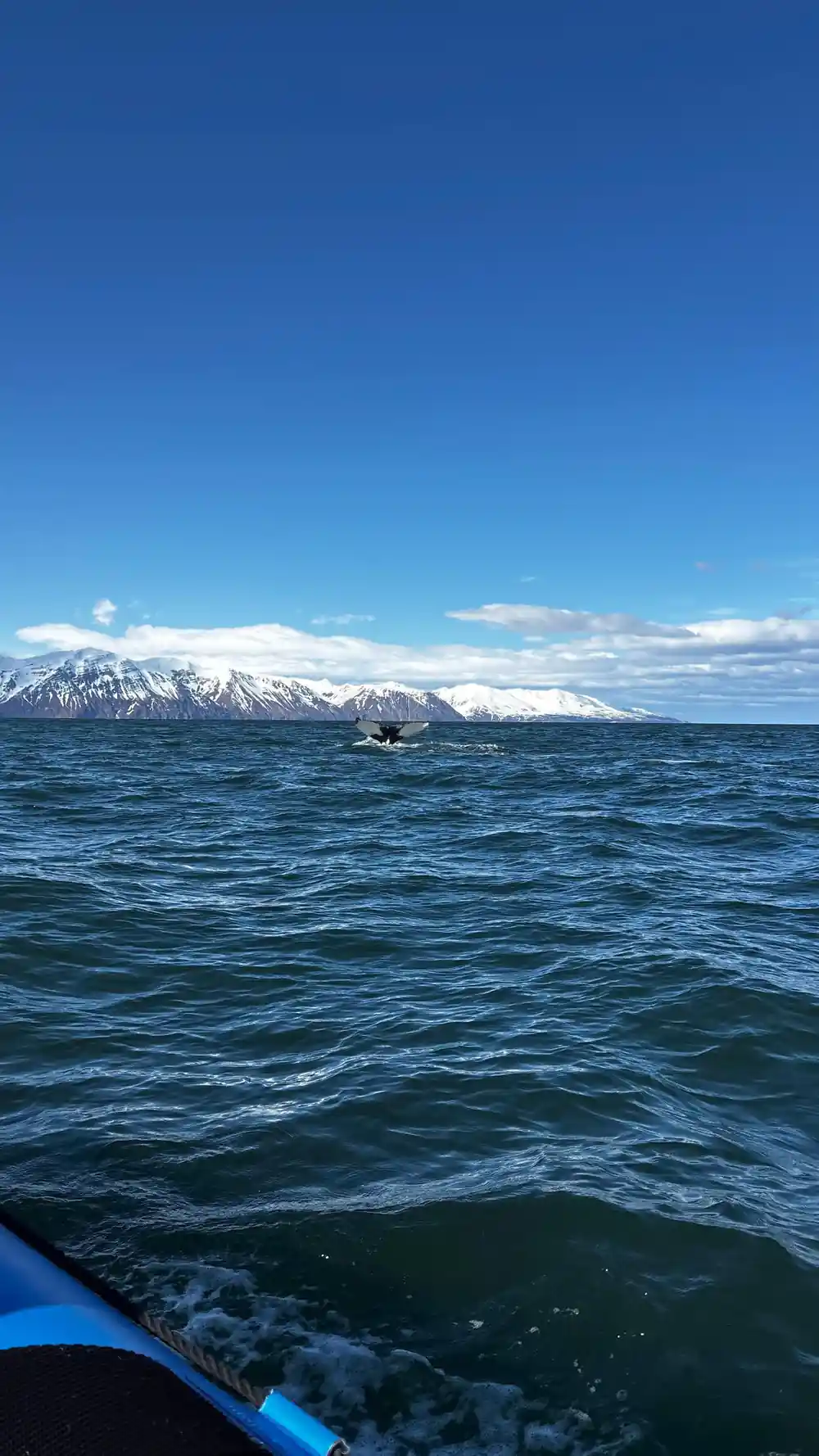
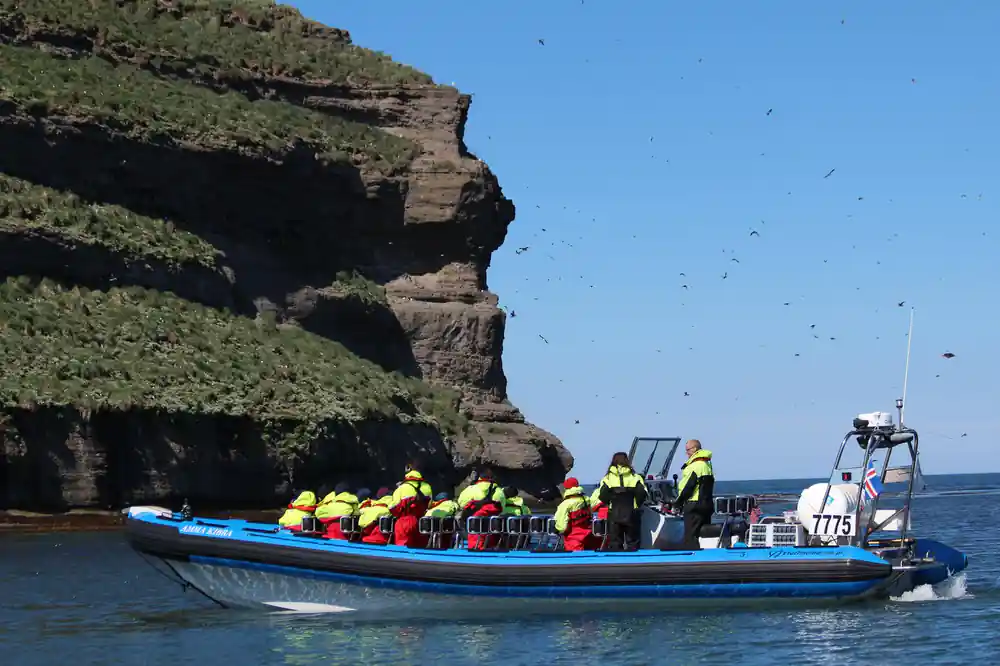
Passengers in flotation gear on a Húsavík dock before a speedboat whale safari
Who Is on Board: Skipper, Guide and Local Knowledge
Two people run most RIB whale watching trips: the skipper, who drives and reads the water, and the guide, who looks after everyone on board and tells you what you are seeing. The guide on the speedboat safari speaks English, and you are welcome to ask questions at any point during the trip.[2] If you are not sure whether you should sit at the front or the back, ask.
Whale watching has deep roots here. Commercial whale watching in Iceland began in Húsavík in 1995, and boats have been heading out into Skjálfandi ever since.[7] North Sailing, one of the operators in town, says there is a chance to encounter up to 11 different cetacean species on its tours, and it reports a 97% overall whale sighting success rate on its Húsavík tours, based on sightings in Skjálfandi Bay since 1995.[8] Humpbacks in the Northern Hemisphere reach an average length of 49 to 52 feet, and the average weight for a mature adult is 50,000 to 80,000 pounds.[9]
Ask the skipper what the forecast is doing before you leave the dock, and what the sea state is likely to be on the way out. Answers given in the harbour are always clearer than guesses made in a swell. Say whether you have spent a lot of time on boats or almost none: it helps the crew look after you and place you where you will be happiest.
Motion Sickness and Vertigo on a Fast Boat
A RIB moves differently from a big whale watching boat. It planes over the surface, so you feel every change in the swell through the seat and the handrail, and the whole outing is short: the speedboat safari lasts 2 hours.[2] The run out is the part that catches people out, because the boat is moving fast and you are sitting low with the water close by.
If you know that motion affects you, take whatever you normally use well before you get on the boat rather than once you are on the water, and mention it at check-in. A short, fast ride can leave a long aftertaste: vertigo hours after a boat ride is a real experience for some travellers, and if it has happened to you, tell the crew so they can seat you where the motion is easiest and keep an eye on you.
Once you are out there, keep your eyes on the horizon rather than on a phone screen, get fresh air on your face, and stay where you can see the sky. On the fast stretches, look at the far shore, breathe slowly, and avoid reading or scrolling. If you start to feel rough, tell the guide early instead of hoping it passes; a seat change or a few minutes facing forward often settles things.
from US$171
The Original Big Whale Safari & Puffins by Speedboat is rated 4.73 from 1,423 reviews and lasts 2 hours.[2]
Weather, Fog and the Shape of Skjálfandi Bay
Skjálfandi Bay is about 28 kilometers wide at its widest point and about 25 kilometers long.[10] Distances on water are hard to judge from the shore, and a bay this size can look flat calm at the harbour while a breeze runs further out. Icelandic forecasts are good, but they change quickly, so read the sky and the water yourself as well as the screen, and ask the crew what they expect. If you scan the bay from land, The Whale Trail advises that one of the best ways to find marine mammals is to look for other people who are watching them, especially stopped boats.[11]
Fog is the condition that surprises people most in the north. It can arrive in minutes and turn a clear morning grey, and it changes what a boat can safely do. If the forecast looks poor and you would rather not go out, the speedboat listing offers free cancellation up to 24 hours in advance for a full refund.[2]
Light is the other thing to plan around. In Iceland the midnight sun peaks around the summer solstice in June, and the sun never fully sets from May through August, so the nights stay bright right across the island.[12] A late departure is therefore not a dark one, and you will not be picking your way back along the pier by torchlight.
Children on Board: Sitting Still at Speed
Children usually love a RIB, but the trip asks something of them: sit down, hold on, and stay where you are put. Seat younger children between two adults, keep hands and arms inside the boat, and agree before you leave the dock who is holding on to whom when the boat accelerates. Explain before you go that the boat will move suddenly and that this is normal, so nobody is startled when it happens.
If a fast open boat is not right for your family, there are slower options. A family-run whale watching tour from US$85 lasts 3 hours, and a whale watching tour with a guide from US$99 also runs 3 hours and is wheelchair accessible.[4][13]
Puffins are one of the rewards of a calmer pace. Lundey, the puffin island in the bay, is a nesting ground for around 36,500 active breeding pairs of puffins.[14] Bring a snack, a drink and a spare layer for each child, and make sure everyone has been to the toilet before boarding, since you stay out for the whole trip.
Radio Contact, Coastguard Coverage and Getting Home
It is reasonable to want to know how the boat stays in touch with the shore. Ask at check-in how the crew communicates with the harbour, who they call if the weather changes, and what happens if someone on board needs to come back early. Harbour crews answer this question all season and will not find it odd.
If you start to feel unwell, cold or frightened while you are out, tell the guide straight away. The sooner the crew knows, the easier it is for them to help: a seat change, a spare layer, a slower run home. Waiting until you are back at the pier turns a small fix into a wasted trip, and there is no prize for toughing it out.
Back on shore, the town makes it easy to warm up and to make sense of what you saw. GeoSea Geothermal Sea Baths are filled with seawater from geothermal boreholes kept at 38 to 39 °C year-round, and entry is from US$60.[15][16] The Húsavík Whale Museum was founded in 1997, and sits a short walk from the harbour.[17] The name Húsavík means 'the house bay', and according to the Settlement Book, Garðar and Náttfari built a house here.[18]
How long the Húsavík boat trips last
Durations as listed on GetYourGuide for four Húsavík whale watching tours.[2][3][4][13]
What a Húsavík day on the water costs
Amounts are US dollar from-prices on GetYourGuide listings.[2][3][4][13][16]
Booking windows for the Húsavík speedboat safari
On the day, step by step
Check in at the harbour
Arrive with time to spare and find the safety board at the dock. Ask about the forecast and the sea state before you board.
Get your flotation suit on
Put it on over thin warm layers, check the collar and cuffs, and ask for a different size if the fit is not right.
Listen to the safety briefing
This is where you learn where to sit, how to hold on and what to do if something goes wrong. Ask if anything is unclear.
Board and settle in
Sit where the crew tells you, stow loose items and keep hands and arms inside the boat. The speedboat safari lasts 2 hours.[2]
Watch and speak up
Keep your eyes on the horizon on the fast stretches, and tell the guide early if you feel cold, sick or uneasy.
Book the Húsavík speedboat safari and let the crew look after the rest
from US$172Reserve now & pay later